Plan your visit to Leonardo Museum Rome
Leonardo Museum is a compact interactive museum in Rome best known for its hands-on reconstructions of Leonardo da Vinci’s inventions and full-size reproductions of his artworks. The visit is short, easy to manage, and especially rewarding if you do not treat it like a major fine-art museum. The biggest difference between a rushed stop and a satisfying one is saving time for the quieter codices and painting rooms after the machine galleries. This guide covers timing, tickets, layout, and practical day-of-visit tips.
Quick overview: Leonardo Museum at a glance
If you want a short, central Rome museum that works for both adults and kids, this is one of the easiest to fit into your day.
- When to visit: Daily from 10am–7pm, with summer extensions to 9pm from May to September; weekdays right at 10am are noticeably calmer than 12 noon–4pm because school groups, families, and heat-weary summer visitors all converge on the hands-on machines later in the day.
- Getting in: From €12 for standard entry, with entry plus audio guide from about €15; you can usually buy on the day, but booking 1–2 days ahead is smarter around Easter, holiday weeks, and hot summer afternoons.
- How long to allow: 45–60 minutes for most visitors, stretching to 75–90 minutes if you use the audio guide, watch the short films, and let kids linger at the bridge-building station.
- What most people miss: The intro film near the entrance and the codices/anatomy section near the end, both of which give the machines the context many visitors feel is missing.
- Is a guide worth it? Usually, an audio guide is better value than a live guide here unless you are visiting with a school group or want deeper art-history context. → See ticket options
Jump to what you need
🕒 Where and when to go
🗓️ How much time do you need?
🎟️ Which ticket is right for you?
🗺️ Getting around
♿ Facilities and accessibility
Where and when to go
How do you get to Leonardo Museum?
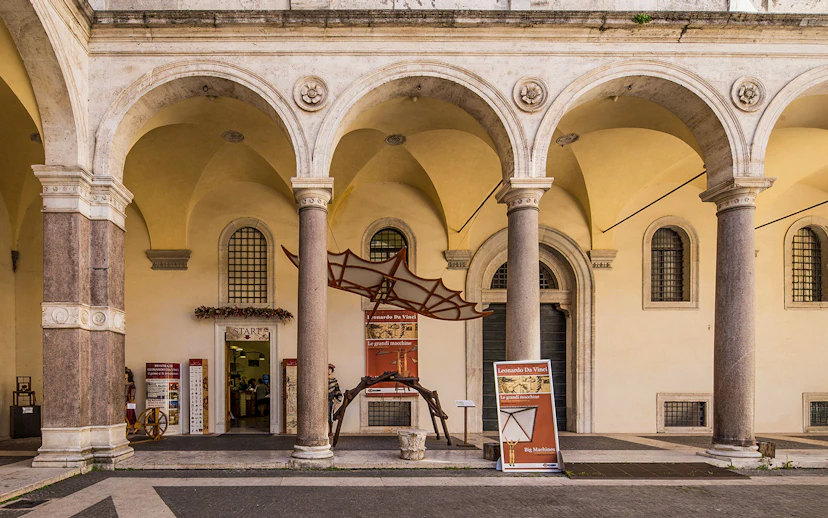
The museum sits beneath Santa Maria del Popolo on the north edge of Piazza del Popolo, beside Flaminio station and about a 10–15-minute walk from the Spanish Steps.
Piazza del Popolo, 12, 00187 Rome, Italy
- Metro: Flaminio station (Line A) → 2-minute walk → exit toward Piazza del Popolo for the church-side entrance.
- Bus / tram: Flaminio or Piazza del Popolo stops → 2–4-minute walk → easiest if you’re crossing the city from the Vatican side.
- Walk: Spanish Steps via Via del Babuino → 10-minute walk → the most straightforward scenic approach from central Rome.
- Taxi / rideshare: Drop-off at Piazzale Flaminio or the edge of Piazza del Popolo → final approach is on foot because the square is largely pedestrianized.
Which entrance should you use?
There is one main public entrance, and the most common mistake is assuming the basilica’s main church doors are also the museum entrance.
- Main entrance: Located on the side of Santa Maria del Popolo at street level. Best for all ticket holders. Expect 0–10 minutes’ wait during summer afternoons and Easter week.
- Accessible side entrance: Located by the side access point with staff assistance. Best for wheelchair users or anyone avoiding steps. Expect little to no wait once staff assist.
When is Leonardo Museum open?
- Monday–Sunday: 10am–7pm
- May–September: Extended hours until 9pm
- December 25: Closed
- Last entry: 1 hour before closing
When is it busiest? Late mornings in April–June, school-trip weekdays in May, and 2pm–5pm in July and August are busiest, when the bridge station and mirror room are hardest to access without waiting.
When should you actually go? Weekdays at 10am, or after 6pm in summer, give you easier access to the hands-on models before family and heat-escape crowds build.
💡 Pro tip: In July and August, the busiest hours are often not the first ones but the hot middle of the day, when people duck inside for air-conditioned indoor time. If you want easier access to the bridge station and mirror room, go at opening or after 6pm in summer.
How much time do you need?
| Visit type | Route | Duration | Walking distance | What you get |
|---|---|---|---|---|
Highlights only | Entrance video → flying machines → war machines → mirror room → exit | 30–40 min | ~0.2 km | Best if you want the interactive core fast; you’ll skip the codices, most painting reproductions, and the slower audio-guide stops. |
Balanced visit | Entrance video → machine galleries → bridge station → mirror room → painting room → codices → exit | 45–60 min | ~0.3 km | The best fit for most visitors because it adds the art and notebook context that makes the inventions feel more than just replicas. |
Full exploration | Entrance video → full machine galleries with hands-on stops → bridge station → videos → painting room → codices/anatomy section → second pass at favorite models → exit | 75–90 min | ~0.4 km | Best if you’re using the audio guide or visiting with curious kids; the extra time comes from lingering, not walking, so patience matters more than stamina. |
Highlights and balanced routes work on standard admission. Full exploration is best with the audio-guide add-on.
✨ The museum is compact, but the link between the machines, codices, and painting rooms isn’t always obvious from the room labels alone. The audio guide turns a quick walk-through into a connected story and helps you avoid skimming past the best context. → See guided tour options
Which Leonardo Museum ticket is best for you
| Ticket type | What's included | Best for | Price range |
|---|---|---|---|
Leonardo Museum admission | Museum entry + interactive galleries + video rooms + full exhibition access | A short Rome stop where you want a flexible, low-commitment museum visit near Piazza del Popolo. | Entry (from €12) ↗ |
Leonardo Museum admission + audio guide | Museum entry + multilingual audio guide + interactive galleries + video rooms | A first visit where you want the inventions and artwork reproductions to connect into a fuller story without booking a live guide. | Entry + audio (from €15) ↗ |
Online pre-booked entry | Museum entry + mobile ticket | A same-day Rome itinerary where you’d rather skip the cashier stop and keep your timing simple. | Online entry (from €14) ↗ |
Group / educational booking | Museum entry + group rate + educational visit on request | A school or large-group visit where you need predictable logistics and a more structured learning format. | Group visit (from €10) ↗ |
How do you get around Leonardo Museum?
Layout and suggested route
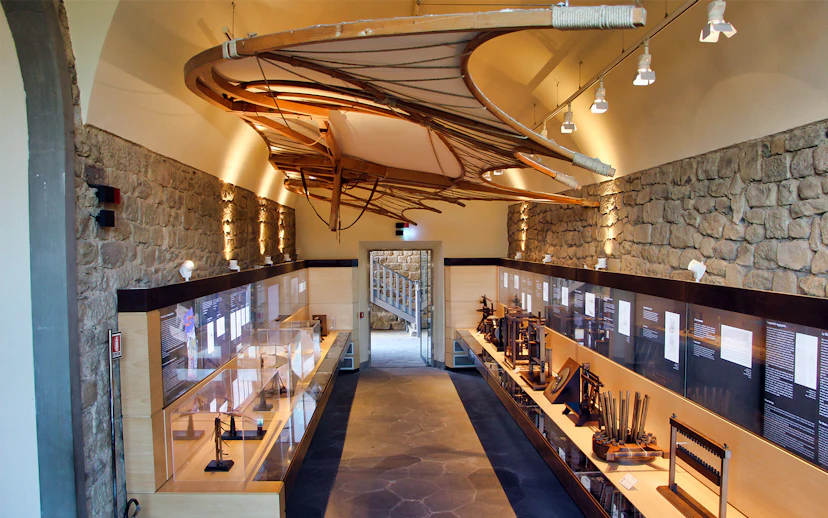
The museum is compact and mostly linear, spread through a sequence of underground vaulted rooms, so it’s easy to navigate but also easy to leave too early once you’ve finished the hands-on machines.
- Entrance and intro zone → ticket desk, short primer film, and orientation panels → 5 minutes.
- Machine galleries → flight, war, hydraulics, and civil-engineering models → 20–25 minutes.
- Bridge station and mirror room → the two most popular hands-on and photo-friendly stops → 10–15 minutes.
- Art and codices rooms → painting reproductions, notebooks, and anatomical studies → 10–15 minutes.
Suggested route: Watch the 5-minute intro first, move through the machine galleries, stop at the bridge and mirror room, and finish in the painting and codices rooms; most visitors rush the final rooms, even though they explain why the inventions matter.
Maps and navigation tools
- Map: A detailed pre-visit map usually isn’t necessary → the museum follows a clear room-to-room sequence → staff orient you at the entrance.
- Signage: Good enough for self-navigation → the only real navigation mistake is skipping the intro and missing the quieter final rooms.
- Audio guide / app: Audio guide in multiple languages, including English → pick it up at the desk → it adds real value if you want more than short labels.
💡 Pro tip: Pick up the audio guide before you enter the first gallery — the ticket desk is easiest to revisit at the beginning, and most people don’t want to backtrack once they reach the hands-on machines.
Where are the masterpieces inside Leonardo Museum?

Flying machines
Attribute — Invention type: Flight engineering
These suspended reconstructions show Leonardo’s obsession with how bodies and wings move through air. Slow down long enough to compare the hang-glider logic with the flapping-wing ornithopter; most visitors look up, take a photo, and move on without noticing how closely the designs study bird anatomy. They’re the clearest reminder that the museum works best when you study mechanisms, not just shapes.
Where to find it: In the first major machine gallery near the start of the visit, overhead and along the opening flight display.
Armored tank and war machines
Attribute — Invention type: Military engineering
The armored tank and early multi-barrel weapon models show a less romantic side of Leonardo’s mind. What many visitors miss is that the real interest is in the gearing, rotation, and loading logic inside the mechanisms, not just the dramatic outer form. Watch the moving parts carefully before you move on, because this section explains how his drawings translated into usable engineering ideas.
Where to find it: In the warfare section of the main machine galleries, after the early flight displays.
Self-supporting bridge
Attribute — Invention type: Civil engineering
This is one of the museum’s best hands-on moments because the idea looks too simple to work until it suddenly locks into place. Many adults stand back and let children take over, but it’s actually one of the clearest demonstrations of Leonardo solving a real structural problem with minimal material. If the station is crowded, come back later rather than skipping it.
Where to find it: At the bridge-building station in the civil-engineering area, roughly mid-way through the museum.
Mirror room
Attribute — Experiment type: Optics and perspective
The mirrored chamber is small, quick, and more memorable than its footprint suggests. People often treat it as just a photo stop, but the real point is Leonardo’s interest in reflection, light, and the idea of the infinite image. Go in when the room is nearly empty if you can, because the effect lands much better without a crowd.
Where to find it: Off the optics and light section in the second half of the galleries.
The Last Supper reproduction
Attribute — Artwork type: Full-scale painted reconstruction
Because the original is in Milan and tightly controlled, this life-size version gives you room to study the composition without rushing. Don’t just stand in the center and move on; walk along the length of it and look at the gestures between the apostles, which many visitors miss after recognizing the scene. This is one of the spots where the audio guide adds the most value.
Where to find it: In the painting gallery toward the later part of the route, after the main machine rooms.
Codices and anatomical studies
Attribute — Display type: Notebook facsimiles and scientific drawings
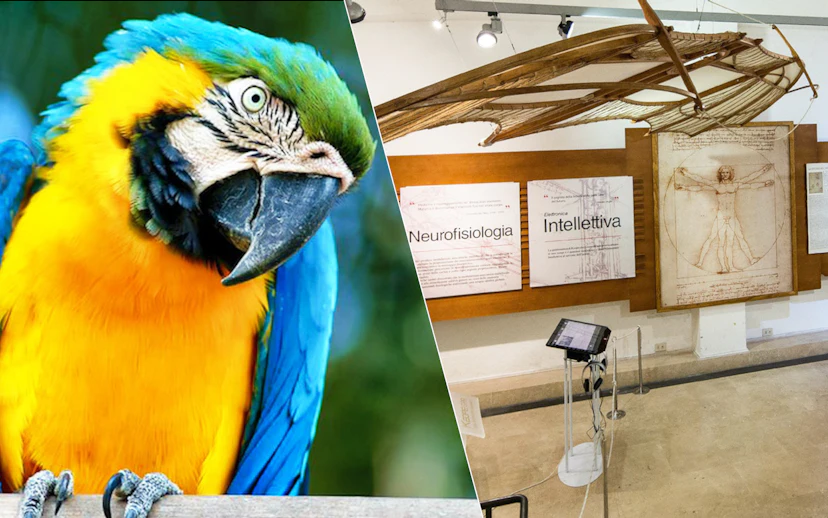
This quieter corner explains the mind behind the machines. The mirrored handwriting, anatomy sketches, and translated notebook pages show how Leonardo observed, tested, and revised ideas, and it’s the section most visitors skip because the interactive models came earlier. Give it 10 minutes and the whole museum feels smarter, more coherent, and less like a collection of isolated curiosities.
Where to find it: In the dimmer final rooms near the end of the visit, beyond the painting reproductions.
💡The 5-minute intro film near the entrance and the codices/anatomy section near the exit are both easy to miss because the hands-on machines pull most visitors forward too quickly.
Facilities and accessibility
- 🎒 Cloakroom / lockers: There isn’t much spare space in the underground galleries, and larger backpacks may be held at staff discretion when it’s busy, so a small bag is the easier choice.
- 🚻 Restrooms: Restrooms are available on-site, which matters because the visit is underground and stepping out breaks the rhythm of a short museum stop.
- 🛍️ Gift shop / merchandise: The small gift shop sits at the exit and focuses on Leonardo-themed books, puzzles, and model souvenirs rather than generic Rome items.
- 🪑 Seating / rest areas: The video room provides the main seated pause during the visit, which is useful for older visitors and anyone pacing a standing-heavy route.
- ♿ Mobility: The museum is mostly wheelchair-accessible inside with flat pathways and ramps, but you should ask staff for the step-free side entrance because the main entry has a few steps.
- 👁️ Visual impairments: The clearest confirmed support is the multilingual audio guide, which helps with context, though the experience remains strongly visual and model-led.
- 🧠 Cognitive and sensory needs: The calmest window is right at opening, and the mirror room plus crowded hands-on stations are the sections most likely to feel overstimulating.
- 👨👩👧 Families and strollers: The route is compact and mostly flat once inside, but the narrow vaulted rooms are easier with a foldable stroller than a bulky one.
This is a strong museum for school-age children because they can test ideas with their hands instead of only reading labels.
- 🕐 Time: 45–60 minutes is realistic with children, or up to 90 minutes if they want repeated turns at the bridge station and interactive machines.
- 🏠 Facilities: The compact layout, on-site restrooms, and seated video room make it easier than Rome’s bigger museums for shorter attention spans.
- 💡 Engagement: Start with the flying machines, then let them try the bridge before you move into the quieter painting and codices rooms.
- 🎒 Logistics: Bring a small bag, skip bulky backpacks, and aim for the 10am opening hour when kids can reach the hands-on exhibits with less waiting.
- 📍 After your visit: Walk up to the Pincio Terrace or into Villa Borghese if your children need open space after the underground galleries.
Rules and restrictions
What you need to know before you go
- Entry requirement: A standard single-use ticket covers the full museum, and online booking mainly saves the cashier stop rather than securing a strict timed slot.
- Bag policy: Small bags are easiest in the tight underground rooms, and larger backpacks may be checked at staff discretion when the museum is crowded.
- Re-entry policy: Admission is single-use, so plan to finish the museum in one pass before heading upstairs to the church or out for food.
- Dress guidance: The museum itself is casual, but modest clothing helps if you also plan to visit Santa Maria del Popolo right afterward.
Not allowed
- 🚫 Food and drink are not allowed in the galleries, so finish snacks and coffee before you go underground.
- 🚬 Smoking and vaping are not part of the indoor visit, so step fully outside the piazza area before lighting up.
- 🐾 Pets are best left out of this short indoor stop, and service-animal arrangements are best checked with staff in advance.
- 🖐️ Touch only the models clearly set up for interaction, and don’t force levers or climb displays because some reconstructions are delicate.
Photography
Photography is generally allowed inside Leonardo Museum, especially in the machine galleries and painting rooms, as long as you keep flash off. The distinction is less about one forbidden room and more about respecting staff guidance around tight, crowded spaces and hands-on stations. Bulky tripods and extended selfie sticks are a bad fit for the narrow vaulted rooms and may be stopped if they block circulation.
Good to know
- The intro film and the codices room near the end are easy to miss, but they are the two areas that give the rest of the museum its best context.
- Because the museum sits below Santa Maria del Popolo, it’s one of the easiest Rome museum visits to pair with free Renaissance and Baroque art upstairs.
⚠️ Re-entry is not permitted once you exit Leonardo Museum. Plan restroom stops, photos, and breaks before leaving — once you head back out to Piazza del Popolo, the visit is treated as finished on a single-use ticket.
Practical tips
- Book 0–48 hours ahead if you want the easiest logistics at Easter, on long weekends, or during hot summer afternoons; on most other days, you can buy at the door, and late arrival is usually less stressful because entry is generally rolling rather than rigidly timed.
- Don’t spend your whole visit in the first machine room. Save 10–15 minutes for the painting reproductions and codices near the end, because that’s where the museum shifts from fun demonstration to useful context.
- The calmest slot is right at 10am. By 12 noon–4pm, families, school groups, and heat-weary tourists tend to converge on the same few hands-on exhibits, especially the bridge station and mirror room.
- Bring a small crossbody or day bag. In the tight underground vaults, big backpacks make the space feel more crowded and may be checked when visitor flow builds.
- Eat before or after, not during. There’s no food inside, but Piazza del Popolo and Via del Corso put coffee, lunch, and gelato within 1–5 minutes on foot.
- If you’re pairing the museum with Santa Maria del Popolo, do the museum first and the church second; the hands-on galleries feel better before you switch into quiet chapel mode.
What else is worth visiting nearby?
Commonly paired: Santa Maria del Popolo
Santa Maria del Popolo
Distance: 0m — 1-minute walk
Why people combine them: It is the most natural pairing possible because the museum sits directly beneath the church, and the shift from Leonardo’s reconstructed ideas to actual Renaissance and Baroque masterpieces feels coherent rather than forced.
Commonly paired: Spanish Steps
Spanish Steps
Distance: 850m — 10-minute walk
Why people combine them: The walk down Via del Babuino is direct, scenic, and easy to fit into the same half-day if you want one compact indoor stop between classic Rome landmarks.
Also nearby
Pincio Terrace
Distance: 300m — 5-minute walk
Worth knowing: It’s the quickest panoramic payoff in the area, and it works especially well after the museum if you want fresh air and a wide city view.
Villa Borghese Gardens
Distance: 600m — 8-minute walk
Worth knowing: This is the best nearby reset if you’re visiting with children or simply want open space after a short underground museum visit.
Eat, shop and stay near Leonardo Museum
- On-site: There is no cafe inside the museum, so treat it as a 45–60-minute visit and plan food in Piazza del Popolo either right before or right after.
- Rosati (1-minute walk, Piazza del Popolo 4/5A): Classic Roman cafe for coffee, pastries, and light lunches if you want the fastest pre-visit stop.
- Dal Bolognese (2-minute walk, Piazza del Popolo 1/2): Traditional Italian restaurant that works best for a slower sit-down lunch once you’re done.
- Babette (4-minute walk, Via Margutta 1/D): A quieter option just off the main visitor flow, good if the piazza itself feels too busy.
- 💡 Pro tip: Eat after the museum, not before, if you’re arriving at opening time — that first hour is the calmest for the bridge station and mirror room.
- Museum gift shop: Leonardo-themed books, puzzles, and small invention souvenirs, located at the exit and better for children than generic Rome magnets.
- Via del Corso: Big-name shopping and easy souvenir browsing begin a few minutes south of Piazza del Popolo, so it’s an effortless add-on after the visit.
Piazza del Popolo is a very good short-stay base if you want to walk to the museum, Villa Borghese, and the Spanish Steps without using transit all day. It feels more polished and a little pricier than some central Rome neighborhoods, but the trade-off is convenience and quick Metro A access. For a first or second night in Rome, it works well.
- Price point: Mid-range to upscale, with the most convenient hotels around the piazza and Via del Babuino carrying a location premium.
- Best for: Short city breaks, museum-heavy itineraries, and families who want the park, metro, and historic center all within easy reach.
- Consider instead: Centro Storico if you want denser sightseeing on foot, or Monti if you’d rather trade polish for a livelier evening scene and slightly better value.
Frequently asked questions about visiting Leonardo Museum
Most visits take 45–60 minutes, though families and audio-guide users can stretch that to 75–90 minutes. It is a compact museum, so the extra time comes from trying the interactive stations, watching the intro film, and spending time in the codices and painting rooms rather than from walking long distances.
Usually, no, but booking 1–2 days ahead is sensible around Easter, holiday weeks, and busy summer afternoons. This is not one of Rome’s hardest tickets to get, and many visitors still buy on the day. Online booking is mainly about convenience, not beating a major sellout risk.
Usually, no, because waits are generally short and the museum does not have the kind of queue that makes a large premium worthwhile. Pre-booking can still save a few minutes at the cashier in busy periods, but most visitors are better off choosing standard entry and adding the audio guide if they want more value.
Arrive 5–10 minutes early if you booked online. That gives you enough time to scan in, collect an audio guide, and get your bearings without stress. The museum is generally more flexible than Rome’s heavily timed major attractions, so this is more about smooth entry than strict slot enforcement.
Yes, small bags are fine, but larger backpacks may be checked if the underground rooms feel crowded. The museum is compact, and bulky bags make the vaulted galleries feel tighter than they already are. If you can, bring a small day bag or crossbody instead of a full-size backpack.
Yes, photography is generally allowed as long as you keep flash off. The machine galleries and painting reproductions are popular photo spots. Because the rooms are narrow, keep tripods and large selfie setups packed away so you do not block circulation around the hands-on exhibits.
Yes, group visits work well here because the museum is short, thematic, and easy to navigate. It is especially popular with school groups and educational outings. If you are coming with a large group, it is worth arranging entry in advance so everyone can move through the interactive stations more smoothly.
Yes, it is one of the easier Rome museums for children aged about 6–12 because many exhibits are hands-on and the full visit is short. Kids usually connect fastest with the flying machines, bridge-building station, and mirror room. It works best if you start with the interactive displays before moving to the quieter art and codices sections.
Mostly, yes, because the interior is largely flat and ramped, but you should ask staff for the step-free side entrance. The main entrance has a few steps. Once inside, the route is much easier than many historic Rome sites, though some hands-on stations may not be set at the most comfortable height for every visitor.
Not inside the museum, but yes, there are plenty of cafes and restaurants within 1–5 minutes on foot. Piazza del Popolo is the easiest place to eat before or after your visit, and Via del Corso gives you more casual options if you want coffee, pastries, or a quick lunch without planning too far ahead.
No, you will see reconstructed machines, facsimiles, and full-size reproductions rather than original Leonardo paintings or notebooks. That is important to know before you go. The strength of the museum is hands-on interpretation and accessibility, not original masterpieces, so expectations matter a lot here.