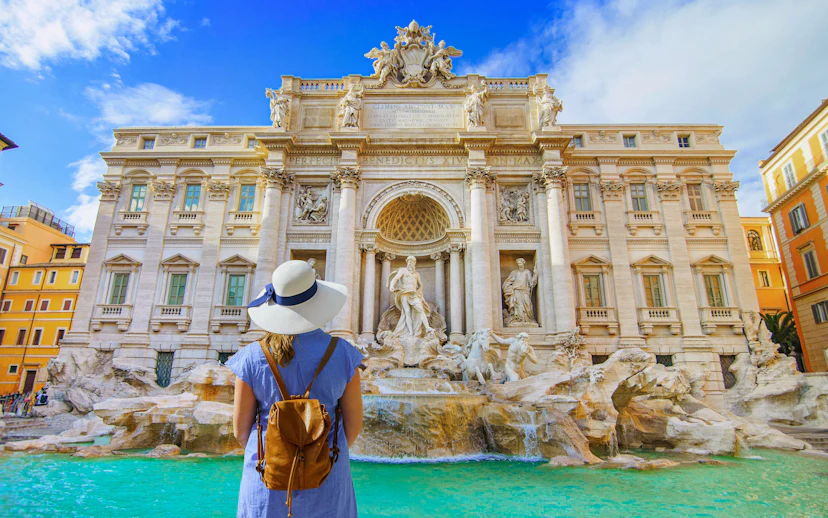
Trevi Fountain visitor guide in Rome
Trevi Fountain is a free public monument rather than a ticketed attraction, so the real planning challenge is timing, crowd flow, and whether you want to add a guided walk or the underground ruins below. It looks like a quick stop, but the difference between a rushed, shoulder-to-shoulder visit and a memorable one often comes down to when you arrive and whether you approach it as part of a wider central Rome route. This guide covers timings, tours, access, and what to prioritize once you’re there.
Quick overview: Trevi Fountain at a glance
You can visit the fountain for free, but a little planning changes the experience more than most people expect.
- When to visit: The square is open day and night, with managed access around the basin from 9am–9pm daily. Before 9am is noticeably calmer than late morning and early evening, and late evening after 9pm feels easier because the daytime crowd-control flow ends.
- Getting in: From $0 for standard entry. Paid walking tours and combo experiences are the better choice if you want context, a smoother route through central Rome, or Pantheon entry bundled in.
- How long to allow: 20–45 minutes works for most visitors. Add up to 1 hour if you want photos, a slower evening stop, or the Vicus Caprarius underground site.
- What most people miss: The Palazzo Poli façade is worth looking at as a full stage set, and the underground Vicus Caprarius adds the ancient water story most people never see.
- Is a guide worth it? Yes, if you’re pairing it with nearby landmarks on a walking route; no, if you only want the coin toss and a few photos.
🎟️ Walking tour slots that include Trevi Fountain are often most convenient when booked ahead for spring, summer, and holiday weekends. Lock in your visit before the time you want is gone. See ticket options
Jump to what you need
🕒 Where and when to go
🎟️ Which ticket is right for you?
🗺️ Getting around
⛲ What to see
♿ Facilities and accessibility
Where and when to go
How do you get to Trevi Fountain?
Trevi Fountain sits in Rome’s historic center, about a 10-minute walk from both the Pantheon and the Spanish Steps, with Barberini as the nearest metro stop.
Piazza di Trevi, 00187 Rome, Italy
- Metro: Barberini (Line A) → 15-minute walk → Follow Via del Tritone downhill toward the historic center.
- Bus: Tritone/Fontana di Trevi stop → 3–5-minute walk → Useful lines include central routes that stop along Via del Tritone.
- Taxi / rideshare: Drop-off near Largo Chigi or Via del Tritone → short walk → The square itself is pedestrian-only.
Which entrance should you use?
There is no ticketed entrance to the square itself, but the main viewing area around the basin follows a managed one-way flow during the day, and that catches people out more than anything else.
- Managed staircase access: There is now a €2 ticket fee if you want to walk down the staircase into the lower basin area (the prime spot to get right up to the water and toss your coin).
- After-hours open access: Once the clock strikes 10pm, the ticket booths close, the staff go home, and the barriers around the lower basin are opened up. You can walk right down to the edge of the water entirely for free. It's also free in the very early morning before 9am.
When is Trevi Fountain open?
- Daily: Open day and night
- Managed access around the basin: Usually runs 9am–9pm
- Last entry: Not applicable for the public square, but daytime access around the fountain may pause when capacity is reached
When is it busiest? 10am–1pm, 5pm–8pm, weekends, and most of June–September are the hardest times for photos and coin tossing because the square fills faster than people move through it.
When should you actually go? Before 9am is your best window for cleaner views, while after 9pm gives you the lit fountain with a looser crowd flow and a more relaxed atmosphere.
Which Trevi Fountain ticket is best for you
| Ticket type | What's included | Best for | Price range |
|---|---|---|---|
Self-guided visit | Free public access to the fountain and square | A flexible stop where you only want the coin toss and photos | Free |
Trevi Fountain & Piazza Navona Guided Walking Tour | Expert, English-speaking guide + small group + central Rome walk | A first visit where you want Rome’s main squares explained without piecing the route together yourself | €22 |
Best of Rome: Spanish Steps, Trevi Fountain & Pantheon Walking Tour | Guided walking tour of central Rome + guided tour of Rome Pantheon + expert English-speaking guide | A short stay where you want Trevi Fountain as part of a stronger city-center route | €34 |
Go City Rome Explorer Pass: Choose 2 to 7 Attractions | Multi-attraction pass + access to selected Rome landmarks, tours, and activities | A longer Rome stay where you want Trevi Fountain as one stop within a wider sightseeing plan | €89 |
Omnia Card and Roma Pass: Access 10+ Attractions and Unlimited Public Transport | 72-hour city pass + selected attractions + unlimited public transport | A packed Rome itinerary where savings and bundled entry matter more than just a fountain stop | €149 |
How do you get around Trevi Fountain?
Trevi Fountain is best explored on foot, and most visits are short enough that you won’t need a formal route unless you’re pairing it with nearby landmarks.
The fountain itself is the focal point, with the main façade directly in front of you as you enter the square and the best side angles opening up from the surrounding lanes.
Key areas and viewpoints
- Front viewing area: The classic full-on view of Oceanus and the basin → 10–15 minutes.
- Side angles on Via dei Crociferi: Better for seeing the scale of the façade and crowd flow → 5–10 minutes.
- Upper edge of the piazza: Useful for wider photos that include the square and surrounding architecture → 5 minutes.
- Vicus Caprarius entrance nearby: Separate underground visit that adds Rome’s ancient water story → 30–45 minutes.
Suggested route: Start from the upper edge of the square for the full reveal, move down for the coin toss once you’ve chosen your photo angle, then step to the side streets for a wider look at the façade; most people rush the center barrier and never really look at the sculptural details above eye level.
Maps and navigation tools
- Map: A simple central Rome walking map or offline city map works best → it helps you connect Trevi Fountain with the Pantheon, Piazza Navona, and the Spanish Steps before you arrive.
- Signage: Wayfinding in the surrounding streets is light → the fountain is easy to find, but a downloaded map helps once you start linking nearby stops.
💡 Pro tip: Don’t make the coin toss your first move — take your wide photos first, because once you get space at the front barrier, you may not want to queue your way back again.
What to look out for at Trevi Fountain

Oceanus and the shell chariot
Attribute — Era: 18th-century Baroque sculpture
This is the image most people come for: Oceanus commanding a shell chariot pulled by two seahorses, one calm and one wild. It’s worth slowing down because the whole composition is about control and movement, not just a single dramatic statue.
Where to find it: Center of the fountain façade, directly above the main basin.
The coin-toss basin
Attribute — Type: Ritual viewpoint
The basin is where the fountain becomes interactive, and that’s a big part of its pull. Tossing a coin over your left shoulder is the classic ritual, but the moment feels better when you pause long enough to hear the water and watch how the space works, not just get the photo.
Where to find it: Front edge of the fountain, behind the viewing barrier.
The Palazzo Poli façade
Attribute — Style: Monumental Baroque architecture
Trevi Fountain is not a freestanding fountain; it’s staged against Palazzo Poli like a theatrical backdrop, which is why it feels so oversized for the square around it. If you only focus on the waterline, you miss how the columns, niches, and windows turn the whole façade into one sculpted set. Look upward for the full effect.
Where to find it: Rising behind the fountain across the entire rear wall.
The allegorical side figures
Attribute — Theme: Abundance and health
On either side of the central niche are figures that give the fountain more meaning than a simple sea-god scene. They reinforce the idea of water as life-giving, useful, and civilizing — exactly the kind of symbolism many visitors miss because they’re locked onto the coin toss.
Where to find it: Flanking Oceanus on the left and right upper sections of the façade.
The nighttime illumination
Attribute — Experience type: Evening view
After dark, the fountain shifts from a daytime landmark to a lit-up urban stage set. The warm lighting pulls out the texture of the travertine and makes the water read differently in photos, especially when the daytime crowd-control route has ended.
Where to find it: Best seen from the upper edge of Piazza di Trevi after sunset.
Vicus Caprarius
Attribute — Type: Underground archaeological site
Just beside the fountain is the hidden layer most people never add: Vicus Caprarius, the small archaeological site tied to the ancient water system beneath this part of Rome. It gives the fountain context instead of treating it as a standalone photo stop. The non-obvious detail is that the story of Trevi starts below street level, not just in the Baroque façade above.
Where to find it: Separate nearby entrance off the lanes beside Trevi Fountain.
Facilities and accessibility
- ♿ Mobility: The square itself is step-free to reach, and wheelchair users can access the piazza, but heavy crowding and uneven surrounding paving can make the approach slow at peak times.
- 👁️ Visual impairments: On-site interpretation is minimal, so an audio-based city walk or guided tour adds more value here than the square alone.
- 🧠 Cognitive and sensory needs: Late evening and early morning are the least overwhelming times because midday crowding, noise, and constant movement can make the square feel overstimulating.
- 👨👩👧 Families and strollers: Strollers can reach the square, but the managed one-way visitor flow and tightly packed front barrier make midday visits frustrating with young children.
Trevi Fountain works well for children because the visit is short, visual, and interactive, especially if the coin toss is the main event rather than the whole plan.
- 🕐 Time: 20–30 minutes is realistic with young children, and longer visits usually only work if you pair the stop with gelato or another nearby square.
- 🏠 Facilities: Family facilities are limited on-site, so plan bathroom stops and snack breaks before or after you reach the fountain.
- 💡 Engagement: Turn the visit into a detail hunt by asking children to spot the calm horse, the wild horse, and the biggest shell before they toss a coin.
- 🎒 Logistics: Bring one coin per child and keep bags light, because the square is easier to manage when you aren’t juggling extra gear in a crowd.
- 📍 After your visit: The Spanish Steps are a natural next stop if children still have energy and you want another short, open-air landmark nearby.
Rules and restrictions
What you need to know before you go
- Entry requirement: Public access to Trevi Fountain is free, and no ticket is needed unless you’re joining a paid walking tour or underground experience nearby.
- Bag policy: Small day bags are fine, but large luggage is a bad idea in the narrow surrounding streets and isn’t practical in the crowd around the basin.
- Re-entry policy: You can leave and come back to the square, but during the 9am–9pm managed-access window you may need to rejoin the visitor flow to get close again.
Not allowed
- 🖐️ Entering the water: Stepping into the basin is prohibited, and fines apply if you ignore the barriers.
- 🖐️ Climbing or sitting on the fountain: Sitting, leaning on, or climbing the monument is not allowed and is actively monitored.
- 🚫 Damaging or removing coins: Coins in the basin are collected by the city and are not for visitors to retrieve.
Photography
Photography is allowed from the square, and Trevi Fountain is one of Rome’s easiest landmarks to shoot day or night. The real limit is behavior, not cameras: don’t climb barriers, enter the basin, or block the narrow viewing space while setting up shots. If you want cleaner photos, your timing matters far more than your equipment here.
Good to know
- One-way daytime flow: During managed hours, the easiest visit comes from following the staircase-to-side-exit route instead of trying to force your way back to the front.
- Night visits feel different: After 9pm the square becomes looser and more atmospheric, but you’ll trade the structured daytime flow for a more informal late-evening crowd.
Practical tips
- Booking and arrival: You don’t need a ticket for the fountain itself, but if you’re joining a guided walk that includes it, arrive at the meeting point at least 15 minutes early because late arrivals usually can’t be accommodated.
- Pacing: Don’t treat Trevi Fountain as a 5-minute photo stop if you care about the details — spend 10 minutes on the front view, then another 10 minutes stepping back to read the full façade and side figures.
- Crowd management: Your best photo window is usually before 9am, while your best atmosphere window is after 9pm, when the illuminated fountain looks better and the daytime route control has ended.
- What to bring or leave behind: Bring one coin and a small bag, not a full daypack; crowded barriers and narrow lanes are much easier to manage when you aren’t carrying extra weight.
- Food and drink: Don’t plan your break at the barrier itself — do the fountain first, then stop for coffee or gelato on the surrounding lanes once you’ve moved out of the busiest part of the square.
- Route planning: Trevi Fountain works best when folded into the Pantheon, Spanish Steps, or Piazza Navona on foot, because that saves you repeatedly entering and exiting the same congested streets.
What else is worth visiting nearby?
Commonly paired: Pantheon
Distance: 800m — about a 10-minute walk
Why people combine them: They fit naturally into the same central Rome walking route, and the contrast between a Baroque fountain and an ancient Roman temple makes the walk feel richer, not repetitive.
✨ Trevi Fountain and the Pantheon are most commonly visited together — and simplest to do on a combo tour. The walking route keeps logistics easy, and Pantheon fast-track entry saves you from ending the route in a ticket line.
Commonly paired: Spanish Steps
Distance: 700m — about an 8–10-minute walk
Why people combine them: They’re close enough to link on foot without extra transit, and both are outdoor landmarks that work well as short stops on the same morning or evening route.
Also nearby
Vicus Caprarius
Distance: A few minutes on foot — just off the lanes beside the fountain
Worth knowing: This is the smartest add-on if you want Trevi Fountain to feel like more than a photo stop, because it explains the ancient water story beneath the square.
Piazza Navona
Distance: 900m — about a 12-minute walk
Worth knowing: It’s another strong open-air stop if you want to keep walking through central Rome’s Baroque core rather than jump straight onto transit.
Eat, shop and stay near Trevi Fountain
- On-site: There is no café at Trevi Fountain itself, but the surrounding streets are packed with coffee bars, gelato shops, and casual tourist-friendly restaurants.
- Via delle Muratte cafés: 2–4-minute walk, streets immediately off the square; coffee, pastries, and quick sandwiches that work well if you want a short stop before continuing to the Pantheon or Spanish Steps.
- Via della Stamperia gelato stops: 3–5-minute walk, lanes just south of the fountain; best for a quick post-visit break when you want something light instead of a full sit-down meal.
- Historic center trattorias nearby: 5–10-minute walk, around the Pantheon side streets; better value than the square itself if you’re ready for a proper lunch or dinner rather than a convenience stop.
- 💡 Pro tip: Eat either before 11:30am or after 2:30pm if you want to avoid both restaurant queues and Trevi Fountain’s busiest mid-day crowd at the same time.
- Piazza di Trevi souvenir stores: Standard Rome keepsakes like magnets, postcards, and small gifts line the lanes around the square, and they’re useful only if convenience matters more than originality.
- Via delle Muratte shopping stretch: A better nearby option if you want to move beyond souvenir counters and browse more mainstream central Rome retail.
Staying near Trevi Fountain is convenient if your priority is being able to walk to Rome’s biggest historic-center sights without relying much on transit. The neighborhood is busy, tourist-heavy, and usually pricier than less central areas, but it works very well for short stays. If you want quieter evenings or better value, this probably isn’t your best base.
- Price point: Central and generally above average, with the biggest premium attached to hotels within a few minutes’ walk of the fountain.
- Best for: A short Rome trip where walking to Trevi Fountain, the Pantheon, Piazza Navona, and the Spanish Steps matters more than local-neighborhood feel.
- Consider instead: Monti or Prati if you want a longer stay, slightly calmer evenings, and a better balance between sightseeing access and day-to-day breathing room.
Frequently asked questions about visiting Trevi Fountain
Most visits take 20–45 minutes. That gives you enough time for photos, the coin toss, and a slow look at the façade from more than one angle. If you’re visiting after dark, waiting for a quieter photo window, or adding Vicus Caprarius, you could easily spend 1–1.5 hours in the area.
No, you do not need a ticket to visit Trevi Fountain itself because the square is free to access. The only time you need to book ahead is if you want a guided walking tour, a combo experience with the Pantheon, or a visit to the nearby underground Vicus Caprarius site.
No, not for the fountain itself, because there is no standard paid admission line to skip. What’s worth booking is a guided walk if you want context, a smoother route through central Rome, or bundled entry to a nearby paid site like the Pantheon or Vicus Caprarius.
If you’re visiting Trevi Fountain on your own, aim to arrive before 9am for the calmest experience. If you’ve booked a walking tour that includes the fountain, arrive at the meeting point at least 15 minutes early, because late arrivals are usually not refunded or re-accommodated.
Yes, you can bring a small bag or backpack to the square. Large luggage is technically possible in the surrounding streets, but it makes the visit awkward because the lanes are narrow, the crowd is dense, and close viewing around the basin works much better when you’re traveling light.
Yes, photography is allowed, and Trevi Fountain is one of the easiest Rome landmarks to photograph from the public square. The real restrictions are behavioral: you cannot climb barriers, step into the water, or block the viewing area while trying to set up long, crowded shots.
Yes, Trevi Fountain works well as part of a group walking route through central Rome. The main thing to know is that large groups move slowly here because the square narrows at the front barrier, so guided routes that combine Trevi with the Pantheon or Piazza Navona usually feel more efficient.
Yes, it’s a strong family stop because the visit is short, outdoors, and built around a memorable ritual. Most families do well with a 20–30-minute stop, especially if each child has a coin ready and you avoid the busiest late-morning and sunset crowd windows.
Partly, yes. The piazza itself is accessible, and wheelchair users can reach the square without stairs, but heavy crowding and uneven paving in the surrounding streets can make the approach and front viewing area slow, especially between 10am and 1pm or at sunset.
Yes, food is easy to find near Trevi Fountain even though there is no on-site café at the monument itself. The surrounding streets have coffee bars, gelato counters, and sit-down restaurants, and it’s smarter to eat after you leave the front barrier rather than try to pause in the busiest part of the square.
Yes, and many visitors prefer it at night. After 9pm the fountain is illuminated, the managed daytime visitor flow usually ends, and the atmosphere feels more relaxed, even though the area still stays busy. If you want the best mix of mood and space, late evening is often better than late afternoon.
Book a walking tour that includes Trevi Fountain as part of a central Rome route rather than looking for a standalone fountain ticket. Options like Best of Rome: Spanish Steps, Trevi Fountain & Pantheon Walking Tour or Combo (Save 19%): Rome Walking Tour + Pantheon Fast-Track Tickets make more sense because they turn a short stop into a fuller itinerary.