Quick Information

RECOMMENDED DURATION

2 hours

VISITORS PER YEAR

500000

EXPECTED WAIT TIME - STANDARD

30-60 mins (Peak), 0-30 mins (Off Peak)

Plan your visit

Did you know?

Pope Sixtus IV, who established the Capitoline Museums in 1471, also commissioned the Sistine Chapel.Pope Sixtus IV's 1471 donation of ancient bronze sculptures laid the foundation for the Capitoline Museums. He also commissioned the Sistine Chapel.

One of the museum's most renowned pieces is the Capitoline Wolf, a striking bronze statue depicting a she-wolf nursing the legendary twins Romulus and Remus, which serves as a powerful symbol of Rome's founding myth.The Capitoline Wolf, depicting the legendary she-wolf nursing Romulus and Remus, has become one of the enduring symbols of Rome and its founding myth.

Michelangelo was the mastermind behind much of the design of the Capitoline Museums, including Palazzo Nuovo, but he passed away before the project was completed.Michelangelo redesigned Piazza del Campidoglio and planned the Capitoline Museums complex, but Palazzo Nuovo was completed after his death following his architectural vision.

Is the Capitoline Museums worth visiting?

The experience feels quieter and more intimate than Rome’s headline monuments. You move between frescoed halls, sunlit sculpture galleries, and cool underground passages, coming face to face with the Capitoline Wolf, the Dying Gaul, and the original equestrian statue of Marcus Aurelius.

The museum began in 1471, when Pope Sixtus IV donated a group of important bronzes to the people of Rome, creating a civic collection rooted in the city’s identity. It later opened as a public museum under Pope Clement XII in 1734. The payoff is a deeper understanding of Rome beyond its ruins. You leave having seen how the city preserved, interpreted, and celebrated its own past across centuries.

Skip it if you have under 90 minutes, feel little interest in sculpture or archaeology, and would rather spend your limited time outdoors.

What to see at the Capitoline Museums
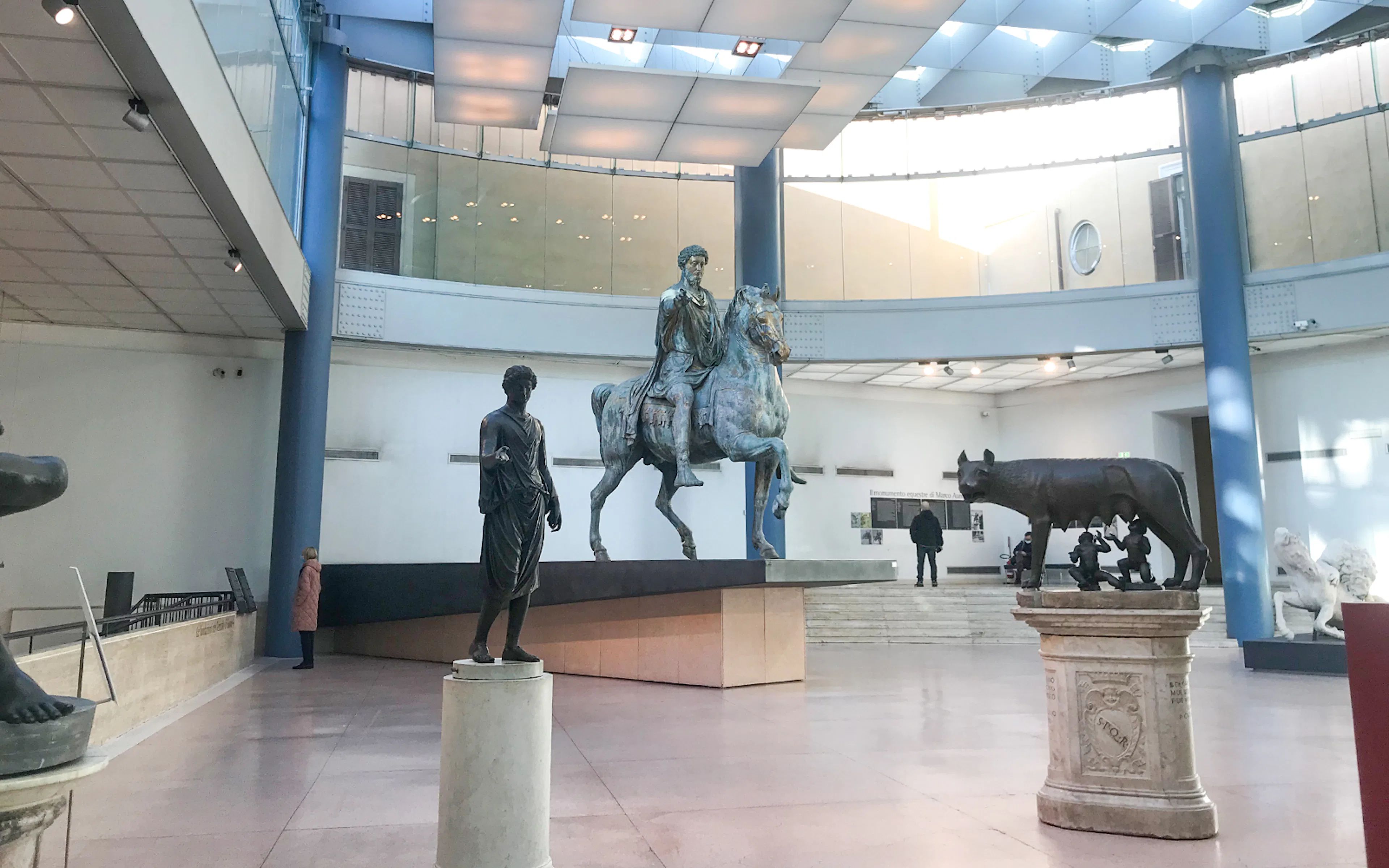
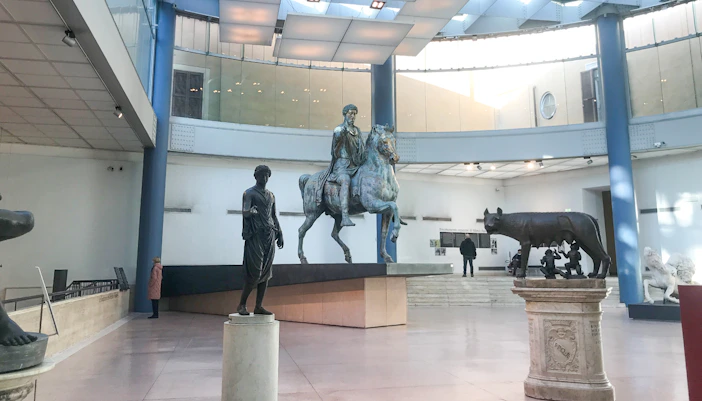
Capitoline Museums statues including Marcus Aurelius on horseback and the Capitoline Wolf in Rome.
1/7

Marcus Aurelius

The statue of Marcus Aurelius is an equestrian bronze honoring the Roman emperor renowned for his philosophical wisdom and stoic values. The statue gives off a sense of power and authority, with the emperor appearing larger than life. His outstretched hand mimics the gesture emperors used when speaking to their troops, adding to the commanding presence.

Capitoline Wolf

Displayed in the Hall of the She-Wolf, this bronze portrays the she-wolf nursing Romulus and Remus, the legendary founders of Rome. Its close connection to the city’s origin story makes it one of the museum’s most recognisable works.

Spinario

The Spinario is a small bronze statue that shows a young boy pulling a thorn from his foot. It arrived at the Capitoline Museums in 1471 as part of a donation by Pope Sixtus IV. Likely created in the 1st century BC, the sculpture blends earlier Hellenistic and Greek influences. During the Renaissance, it was one of the most admired and frequently copied ancient pieces.

Lion attacking a horse

The Lion attacking a horse statue is a marble sculpture from the Hellenistic era, displayed at the Capitoline Museums in Rome. It captures a dramatic struggle between a lion and a horse, showcasing intense emotion and dynamic movement. The piece has been on Capitoline Hill since at least the early 14th century.

Capitoline Venus

Discovered between 1666 and 1670 near the Basilica of San Vitale, this sculpture stands slightly larger than life. Crafted from exquisite marble, likely sourced from Paros, it portrays Venus looking a bit lost and empty as she exits her bath.

Dying Gaul

The Dying Gaul, also known as The Dying Galatian or The Dying Gladiator, is an ancient Roman marble statue that depicts a semi-reclining figure. This piece is a replica of a lost Greek sculpture from the Hellenistic era (323–31 BC), which is believed to have originally been crafted in bronze.

Cupid and Psyche

Located in the Capitoline Museums in Rome, the statue of Cupid and Psyche is a 1st or 2nd-century replica inspired by an earlier late Hellenistic original. Donated by Pope Benedict XIV after its discovery in 1749, it beautifully depicts the lovers entwined in a tender embrace.
How to explore the Capitoline Museums

How much time to spend?

  • Allow 2–3 hours to explore the main collections without rushing.
  • A focused 90-minute visit can cover the Capitoline Wolf, Marcus Aurelius, Dying Gaul, and Capitoline Venus.
  • Add 45–60 minutes for the Picture Gallery or a temporary exhibition.

Best visit order

  • Enter through Palazzo dei Conservatori and begin with the Capitoline Wolf, the Hall of the Horatii and Curiatii, and the Marcus Aurelius Exedra.
  • Continue through the underground Galleria Lapidaria to the Tabularium viewpoint.
  • Finish in Palazzo Nuovo, where the major sculpture galleries are located. This order keeps the route logical and avoids unnecessary backtracking.

Must-see highlights

  • Must-see: Capitoline Wolf, Marcus Aurelius, Colossus of Constantine, Dying Gaul, Capitoline Venus, and the Roman Forum view from the Tabularium.
  • Optional: The Capitoline Picture Gallery and temporary exhibitions, which can add another 45–60 minutes.

Worth adding nearby

  • Roman Forum: Directly below Capitoline Hill and worth another 1.5–2 hours.
  • Vittoriano panoramic terrace: Around a five-minute walk away and adds roughly one hour.
  • Self-paced visitors should pair the museum with one of these rather than trying to fit all three into a short visit.

Guided or self-paced?

  • Choose self-paced if you mainly want to see the major sculptures, galleries, and viewpoints.
  • Choose a guided visit if you want the mythology, imperial symbolism, and links between the artworks and ancient Rome explained clearly.
  • The multimedia introduction is also useful for first-time visitors who want historical context before entering the galleries.

Capitoline Museums guided tour →

Brief history of the Capitoline Museums

  • Middle Ages: After the fall of the Roman Empire, Capitoline Hill gradually regained its importance as the civic and political centre of Rome.
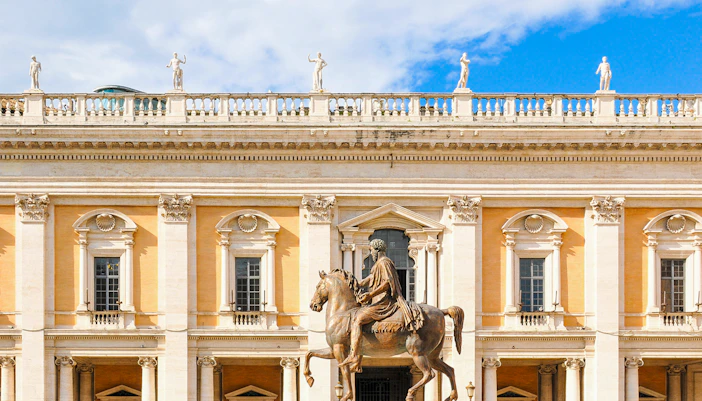
  • 16th century: Michelangelo redesigned Piazza del Campidoglio and the surrounding palaces. In 1538, Pope Paul III moved the equestrian statue of Marcus Aurelius to the square, where it became the focal point of the new design.
  • 1654: Palazzo Nuovo was completed opposite Palazzo dei Conservatori, creating more exhibition space and establishing the museum complex seen today.
  • 1734: Pope Clement XII officially opened the Capitoline Museums to the public after acquiring Cardinal Albani’s collection, making them the world’s oldest public museum.
  • Mid-18th century: Pope Benedict XIV established the Capitoline Picture Gallery by combining the Sacchetti and Pio collections.
  • 1952–1957: New galleries were added to display Latin and Greek inscriptions and expand the archaeological collections.
  • 1997: Major renovations transformed the complex, adding spaces such as the Galleria Lapidaria and the Capitoline Coin Cabinet.
  • Present day: The museums continue to expand through new exhibitions, conservation projects, and gallery spaces.

Architecture and design of the Capitoline Museums

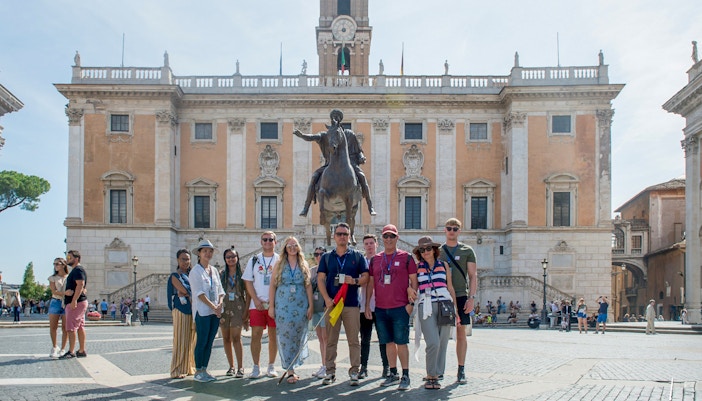
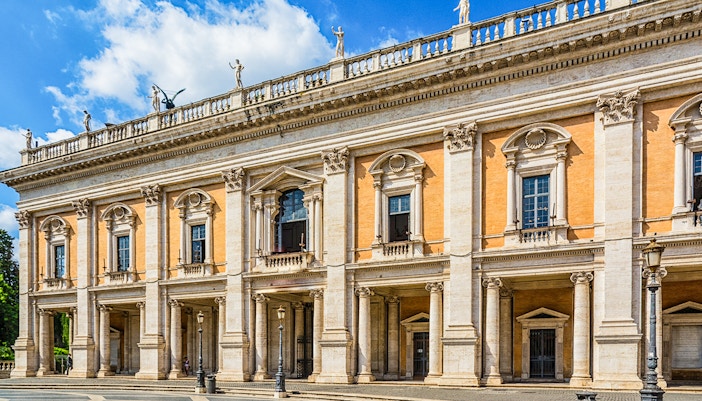
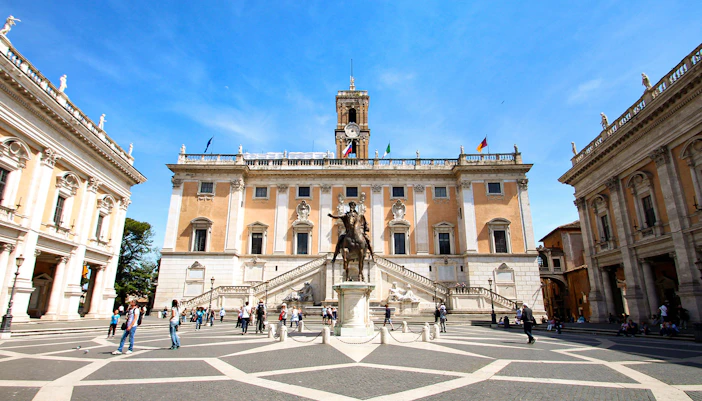
The Capitoline Museums combine ancient Roman foundations with Renaissance and Baroque palace architecture. Palazzo dei Conservatori and Palazzo Nuovo face each other across Piazza del Campidoglio, creating a balanced, theatrical setting that draws visitors toward the centre of the square. Michelangelo redesigned the complex using strong geometric symmetry, broad pilasters, arcaded porticoes, and the gently rising Cordonata staircase.

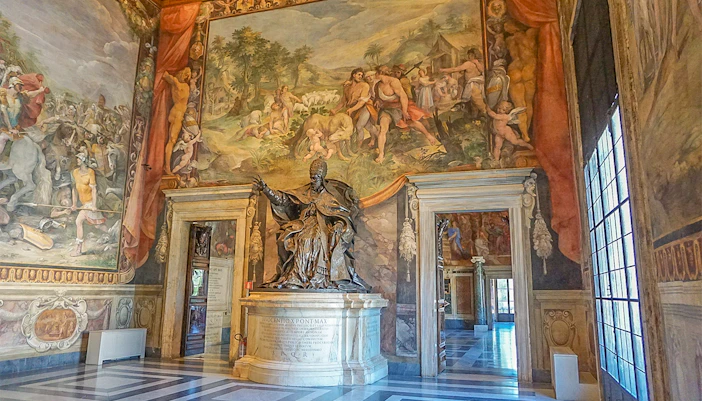
Palazzo dei Conservatori features monumental Corinthian pilasters and Ionic columns, while the underground Galleria Lapidaria connects the palaces through the ancient Tabularium. As you move through the complex, formal palace rooms give way to stone-lined passages and open views over the Roman Forum, making the architecture feel like a journey through several layers of Rome.

Who designed the Capitoline Museums?

Michelangelo was commissioned by Pope Paul III in 1536 to redesign Piazza del Campidoglio and unify its surrounding buildings. He planned the square, façades, staircase, and placement of the Marcus Aurelius statue, although much of the work was completed after his death by architects following his designs.

Trio of museums

Palazzo dei Conservatori

Adjacent to the Palazzo Senatorio, the Palazzo dei Conservatori showcases a collection of ancient Roman artifacts. Originally constructed for the city magistrates, Michelangelo transformed its façade in the 1530s, incorporating colossal pilasters and a grand portico. This building serves as a vibrant hub for art and history, with highlights like the Capitoline Wolf.

Visit Palazzo dei Conservatori

Palazzo Nuovo

The Palazzo Nuovo complements the Palazzo dei Conservatori, completing the symmetry of the Piazza del Campidoglio. Finished in 1654 and opened to the public in 1734, it houses an impressive array of classical sculptures, mirroring its neighbor's architectural style and further enriching the Capitoline Museums.

Explore Palazzo Nuovo

Palazzo Senatorio

The Palazzo Senatorio crowns the Capitoline Hill, originally built in the 13th and 14th centuries atop the ancient Tabularium. It serves as Rome's city hall today and features an impressive double staircase designed by Michelangelo, leading up to a façade adorned with Corinthian pilasters.

Know more about Palazzo Senatorio

Frequently asked questions about the Capitoline Museums

The museums take their name from Capitoline Hill, one of Rome’s seven historic hills and a centre of civic and religious life since antiquity. The collections occupy several buildings arranged around Piazza del Campidoglio.

More reads

Plan your visit

Palazzo Nuovo

Capitoline Wolf