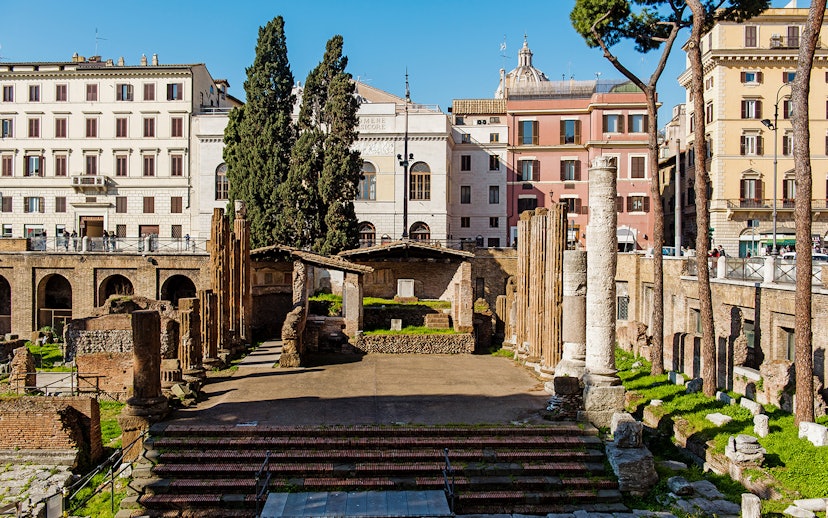
Visiting Largo Argentina: your complete guide
Largo Argentina is a compact archaeological site in central Rome best known for its Republican-era temple ruins and its link to Julius Caesar’s assassination. The visit is short, open-air, and easy to underestimate from the street because most of the site sits below modern road level. What changes the experience most is arriving with a clear plan for your timed entry and knowing what to look for beyond Temple B. This guide covers timing, access, tickets, route, and the details that make a 45-minute visit feel worthwhile.
Quick overview: Largo Argentina at a glance
If you’re fitting this stop into a busy day in central Rome, these are the details that matter most.
- When to visit: Tuesday–Sunday, usually 9:30am–4pm in winter and 9:30am–7pm in summer. The first slot at 9:30am feels noticeably calmer than 11am–3pm, because the site catches spillover foot traffic from the Pantheon, Piazza Navona, and nearby bus stops by late morning.
- Getting in: From €22 for standard entry. You can often book close to your visit date, but weekends and spring–summer afternoons are worth locking in earlier.
- How long to allow: 45–60 minutes for most visitors. It stretches toward the longer end if you watch the video first, read the displays, and stop by the cat sanctuary.
- What most people miss: The artifact displays under the medieval portico and the cat sanctuary add more to the visit than most first-timers expect.
- Is a guide worth it? A live guide isn’t essential for such a compact site, the included audio guide adds value if you want to make sense of the Caesar story and the temple chronology.
Jump to what you need
🕒 Where and when to go
🗺️ Getting around
🏛️ What to see
♿ Facilities and accessibility
Where and when to go
How do you get to Largo Argentina?
Largo Argentina sits in Rome’s historic center, between the Pantheon and Piazza Venezia, and works best as a walk-in stop while you’re already sightseeing downtown.
Largo di Torre Argentina, 00186 Rome, Italy
- Bus: Largo di Torre Argentina stop → 1–2-minute walk → Best option from Termini, the Vatican area, and other central neighborhoods.
- Tram: Line 8 terminus near Largo Argentina → 2–3-minute walk → Useful if you’re coming from Trastevere.
- Metro + walk: Nearest Metro stations are not close → 15–20-minute walk → Switch to a bus if you want the easiest arrival.
- Taxi / rideshare: Drop-off at Largo di Torre Argentina → immediate access → Easiest choice if you want to avoid central Rome’s uneven pavements.
Which entrance should you use?
There is one public visitor entrance, located at the street-level access point to the archaeological area. Expect 5–15 minutes wait during late-morning and early-afternoon weekend slots.
When is Largo Argentina open?
- Tuesday–Sunday: 9:30am–4pm in winter
- Tuesday–Sunday: 9:30am–7pm in summer
- Monday: Closed
- Last entry: Around 3pm in winter and 6pm in summer
When is it busiest? Late morning to mid-afternoon, especially on weekends from April to October, when central Rome sightseeing traffic makes the compact walkways feel fuller than the site’s short duration suggests.
When should you actually go? The 9:30am slot or the final 90 minutes of the day give you more breathing room, better sightlines around Temple B, and less crowd spillover from nearby squares.
How do you get around Largo Argentina?
Layout and route
Largo Argentina is best explored on foot, and most visitors cover it fully in 30–45 minutes once they’re inside. The route is simple, but the site rewards a deliberate clockwise circuit instead of a quick look at the first columns you see.
The main visual focal point sits near the center of the site at Temple B, while the Curia of Pompey remains and smaller interpretation areas are easier to miss if you rush the perimeter.
- Temple B: Circular temple with standing Corinthian columns → 10 minutes.
- Temple C: Oldest sanctuary on site, with a heavy tuff base and layered archaeology → 5–10 minutes.
- Curia of Pompey area: Best-known historical point because of Caesar’s assassination connection → 5–10 minutes.
- Exhibition bays: Small displays with inscriptions, fragments, and finds from the site → 5 minutes.
- Cat sanctuary edge: Short stop if you want to see the cats without derailing the visit → 5–10 minutes.
Suggested route: Start with Temple B for orientation, continue toward Temple C and the broader temple remains, then slow down at the Curia of Pompey area before finishing with the exhibits and cat sanctuary, which many people miss because they mentally ‘finish’ the visit once they’ve seen Caesar’s spot.
Maps and navigation tools
- Map: A paper city map is included with the Headout package and helps you place the site within a wider central Rome walking route.
- Signage: Wayfinding on-site is enough for the physical route, but not enough if you want to understand the temple sequence without extra context.
- Audio guide / app: The Rome audio guide app adds more value than the on-site panels alone, especially for the Curia of Pompey and the Republican temple chronology.
💡 Pro tip: Download the audio guide and open your ticket instructions before you arrive, because this is a short visit and losing 10 minutes at the start makes a noticeable difference.
Get the Largo Argentina map / audio guide
What are the most significant spaces in Largo Argentina?

Temple B
Era: 101 BC
Temple B is the most visually striking ruin on site and the easiest one to read at a glance because of its circular plan and surviving Corinthian columns. It’s the temple most visitors photograph first, but many rush past the fact that its rounded design makes it unusual among Roman sanctuaries in the city center. Slow down long enough to notice the podium height and how much of the original form still registers.
Where to find it: Near the center of the archaeological area, and the clearest structure visible from multiple points on the walkway.
Temple C
Era: 4th–3rd century BC
Temple C is the oldest sanctuary at Largo Argentina, and it matters more historically than it first appears. What looks like a low, worn platform is actually one of the site’s strongest reminders that this place belongs to Republican Rome, not the later Imperial city most travelers picture. Many visitors glance at it after Temple B and move on too quickly to notice the rougher stone and earlier building phase.
Where to find it: On the walkway circuit beside the better-preserved temple remains, marked by its broad tuff base.
Curia of Pompey area
Historical event: Julius Caesar’s assassination, 44 BC
This is the part of Largo Argentina that turns a compact ruin site into a genuinely memorable stop. The surviving remains relate to the Curia of Pompey, the place long associated with Caesar’s murder, and that connection gives the site far more weight than its small footprint suggests.
Where to find it: Along the walkway near the section linked to Pompey’s Theatre and the explanatory panels about Caesar.
Exhibition spaces
Type: Archaeological finds and interpretation displays
The exhibition areas are easy to skip because they don’t dominate the skyline the way Temple B does, but they’re where the site stops being just a set of ruins and starts feeling legible. You’ll see inscriptions, sculptural fragments, and finds uncovered during excavation, which help connect the stone foundations to the people who used them.
Where to find it: Under the medieval portico along the visitor route, near the latter part of the circuit.
Torre Argentina Cat Sanctuary
Type: Living cat sanctuary within the archaeological area
The cat sanctuary is not the reason most people come, but it’s often the detail they remember afterward. Seeing rescue cats lounging around one of Rome’s most historic ruin sites gives Largo Argentina a warmth that many archaeological stops don’t have. This is an active volunteer-run sanctuary, not just a few strays among the stones.
Where to find it: At the edge of the site, beside the ruins and close to the exit area.
Facilities and accessibility
- 🎒 Cloakroom / lockers: There are no lockers or wardrobes on-site, so arrive with only a small bag you can keep with you.
- 🚻 Restrooms: There are no toilets inside the site, so use a café or public restroom nearby before your timed entry.
- 🍽️ Food and drink: There is no café or snack bar inside Largo Argentina, and the short visit works best if you eat beforehand.
- 📶 Wi-Fi: Wi-Fi is available through the meeting-point service included with the Headout package, not across the archaeological site itself.
- 🗺️ Map: A paper city map is included with the Headout experience and is useful if Largo Argentina is one stop in a longer central Rome walk.
- 🐈 Cat sanctuary: The volunteer-run Torre Argentina Cat Sanctuary sits beside the ruins and adds a worthwhile extra stop if you have 10 more minutes.
- ♿ Mobility: The site now has an elevator, ramps, and level walkways, so wheelchair users can access the visitor route more easily than at many Rome ruin sites.
- 👁️ Visual impairments: A tactile model at the entrance helps with orientation, guide dogs are allowed, and the audio guide adds useful context where panels are limited.
- 🧠 Cognitive and sensory needs: The opening slot is the calmest, while the loudest part of the experience is usually the street traffic above rather than the archaeological area itself.
- 👨👩👧 Families and strollers: The route is stroller accessible, and the flat walkway makes it one of the easier ancient sites in Rome to manage with younger children.
Largo Argentina works well with children if you want a short, story-led history stop rather than a museum-heavy visit, and the cats help keep younger visitors engaged.
- 🕐 Time: 30–45 minutes is realistic with children, especially if you focus on Temple B, the Caesar story, and the cat sanctuary.
- 🏠 Facilities: The site is stroller accessible, but the lack of on-site restrooms means you should handle bathroom stops before entry.
- 💡 Engagement: Tell children to look for 3 things as they go — round Temple B, the place linked to Caesar, and the sanctuary cats — and the route feels much more interactive.
- 🎒 Logistics: Bring a small bag, water for before or after the visit, and arrive early in the day when the route feels less crowded.
- 📍 After your visit: Piazza Navona is a short walk away and gives children more room to move after the compact archaeological circuit.
Rules and restrictions
What you need to know before you go
- Entry requirement: You’ll need a valid ticket for your timed or reserved slot, and it’s smart to carry the ID noted on your booking because some packages ask for it at check-in.
- Bag policy: Large luggage and oversized bags are not allowed, and there are no lockers on-site to store them for you.
- Re-entry: Plan your visit as one short circuit, because this is not the kind of attraction you casually leave and return to later in the day.
Not allowed
- 🚫 Food and drink: Bottles, glass containers, alcoholic beverages, and aerosols are not allowed inside.
- 🐾 Pets: Pets are not allowed, but guide dogs are permitted.
- 🖐️ Touching and climbing: Do not climb on the ruins or cross barriers, because the surviving stonework is fragile and the visitor route is tightly controlled.
Photography
Personal photos are one of the easier parts of the visit because the site is open-air and compact. The distinction is practical rather than room-by-room: stay on the walkways, don’t lean over barriers for a better angle, and keep bulky equipment from blocking the route. Flash, tripods, and anything that slows circulation are a poor fit for the narrow viewing platforms.
Good to know
- Monday closure: Largo Argentina is closed every Monday, which catches out more walk-up visitors than anything else.
- Seasonal timing: Closing time shifts with the season, so the last-entry window matters if you’re trying to fit this in late in the day.
Practical tips
- Booking and arrival: You can often book Largo Argentina close to your visit date, but spring and summer weekends are easier if you reserve ahead, and if your ticket includes the multimedia video or assistance, read the meeting-point instructions carefully instead of going straight to the railings.
- Pacing: Don’t spend your whole visit on Temple B first, because the Curia of Pompey area and the exhibition spaces are where the site gains context.
- Crowd management: The 9:30am slot works best here because central Rome foot traffic has not yet spilled in from the Pantheon, Piazza Navona, and the surrounding bus stops.
- What to bring or leave behind: Bring a small bag and your ID, and leave glass bottles, alcohol, aerosols, and anything bulky behind because there are no lockers to bail you out.
- Food and drink: Eat or grab coffee before entry, not after you’re inside, because there is no café or restroom on-site and the visit is short enough that a pre-visit stop makes the whole experience easier.
- Make the extras count: If your ticket includes the 30-minute Ancient Rome multimedia video, watch it before entering, because it does more to frame this compact site than most visitors expect.
What else is worth visiting nearby?
Commonly Paired: Pantheon
Distance: 500 m — 6-minute walk
Why people combine them: It’s one of the cleanest same-day pairings in central Rome, because Largo Argentina gives you Republican-era ruins while the Pantheon shows you Rome’s later architectural confidence in one short walk.
Commonly Paired: Capitoline Museums
Distance: 700 m — 10-minute walk
Why people combine them: This works well if you want Largo Argentina’s open-air archaeology first and then a museum visit that gives you more objects, inscriptions, and historical context afterward.
Also nearby
Piazza Navona
Distance: 450 m — 6-minute walk
Worth knowing: It’s an easy next stop if you want to shift from archaeology to street life, fountains, and a more relaxed central Rome wander.
Campo de’ Fiori
Distance: 550 m — 7-minute walk
Worth knowing: This makes more sense after Largo Argentina than before it, especially if you want lunch, a market atmosphere, or an easy bridge toward the Jewish Ghetto and Trastevere.
Eat, shop and stay near Largo Argentina
- On-site: There is no café or snack bar inside Largo Argentina, so this is best treated as a short stop between meals rather than a place to linger over food.
- Piazza di Torre Argentina cafés: (2–4-minute walk, around the square): Best for a quick espresso or pastry before your slot because you stay close to the entrance area.
- Campo de’ Fiori trattorias: (7-minute walk, Campo de’ Fiori area): Better after your visit if you want a sit-down lunch and are continuing west through the historic center.
- Pantheon coffee bars: (6-minute walk, Pantheon area): Useful if Largo Argentina is one part of a longer central Rome route, though you’ll usually pay a little more for the location.
- 💡 Pro tip: Use the bathroom and grab coffee before you go in, because once your visit starts there’s no on-site café, no restroom, and no reason to break a 45-minute circuit in half.
- Campo de’ Fiori market area: Good for edible souvenirs, pantry staples, and small Roman gift buys if you want something more local than a standard museum shop.
- Historic center gift shops around the Pantheon and Piazza Navona: More convenient than distinctive, but useful if you want books, postcards, or easy last-minute souvenirs on the same walking route.
Yes, if you want to walk almost everywhere in central Rome and don’t mind paying for the convenience. This part of the historic center is busy, practical, and very easy for short stays built around major sights like the Pantheon, Piazza Navona, Campo de’ Fiori, and Largo Argentina itself. It makes the most sense for visitors who value location over quiet evenings and bigger rooms.
- Price point: The area usually skews mid-range to expensive, especially around the Pantheon and Piazza Navona, with better-value pockets appearing only if you book early.
- Best for: Short city breaks where you want to step out of your hotel and start sightseeing on foot with almost no transit planning.
- Consider instead: Trastevere works better if you want more evening energy and food options, while Monti is often a stronger fit for longer stays that still need central access without quite the same historic-center price pressure.
Frequently asked questions about visiting Largo Argentina
Most visits take 45 minutes to 1 hour. That gives you enough time for the full walkway circuit, the main temple remains, the Curia of Pompey area, and the small exhibition spaces. If your ticket includes the 30-minute multimedia video and you watch it first, plan closer to 1.5 hours from start to finish.
No, you do not always need to book far in advance, but it helps on weekends and during the spring and summer travel season. Largo Argentina is not on the same sellout level as the Colosseum or Vatican Museums, yet timed slots are still the easiest way to avoid friction if you’re fitting it into a fixed sightseeing day.
Arrive about 10–15 minutes early. That gives you enough time to sort out ticket checks or meeting-point instructions without eating into a visit that only lasts about 45–60 minutes. If your booking includes the multimedia video or assisted check-in, allow a little more time and follow the voucher directions carefully.
Yes, but keep it small. Large luggage and oversized bags are not allowed, and there are no lockers or wardrobes on-site, so anything bulky becomes a problem immediately. A small day bag is the safest option for a quick central Rome stop like this.
Yes, most visitors take personal photos on the walkways. The site is open-air, so photography feels straightforward, but you should stay behind barriers and avoid anything that blocks circulation on the narrow route. If you want cleaner shots, go at opening or in the last part of the day.
Yes, but groups work best when everyone is booked into the same timed slot. Because the site is compact and the walkways are controlled, very loose group arrivals are harder to manage than at larger attractions. If you want more historical depth, this is one of those places where a small guided group makes more sense than a big one.
Yes, especially if you want a short history stop rather than a long museum visit. Most families spend 30–45 minutes here, and the mix of temple ruins, the Caesar story, and the cat sanctuary helps hold children’s attention better than a purely text-heavy site. Just plan around the lack of on-site restrooms.
Yes, the visitor route is now much more accessible than many Roman ruin sites. There is an elevator down to the archaeological area, and the raised walkways are level and easier to manage than uneven excavation ground. It is also stroller accessible, which matters for families traveling with younger children.
Food is available near Largo Argentina, but not inside it. There is no on-site café or snack bar, so it’s smarter to treat this as a short stop between meals and use one of the nearby cafés or restaurants before or after your timed entry.
Yes, you can usually see the cat sanctuary area as part of the wider visit. For many people it’s a charming extra rather than the main reason to come, but it’s worth saving a few minutes for if you like animals. The sanctuary is volunteer-run, which gives the site a more personal, local feel.
Yes, that historical connection is one of the main reasons people visit. The site includes remains linked to the Curia of Pompey, the place traditionally associated with Caesar’s assassination in 44 BC. It is not a huge theatrical reconstruction, so the impact comes from knowing the history before you arrive.
No, Largo Argentina is closed on Mondays. It usually opens Tuesday through Sunday, with seasonal closing times that shift between winter and summer. If you’re planning a late-day visit, check the current last-entry time as well as the headline opening hours.