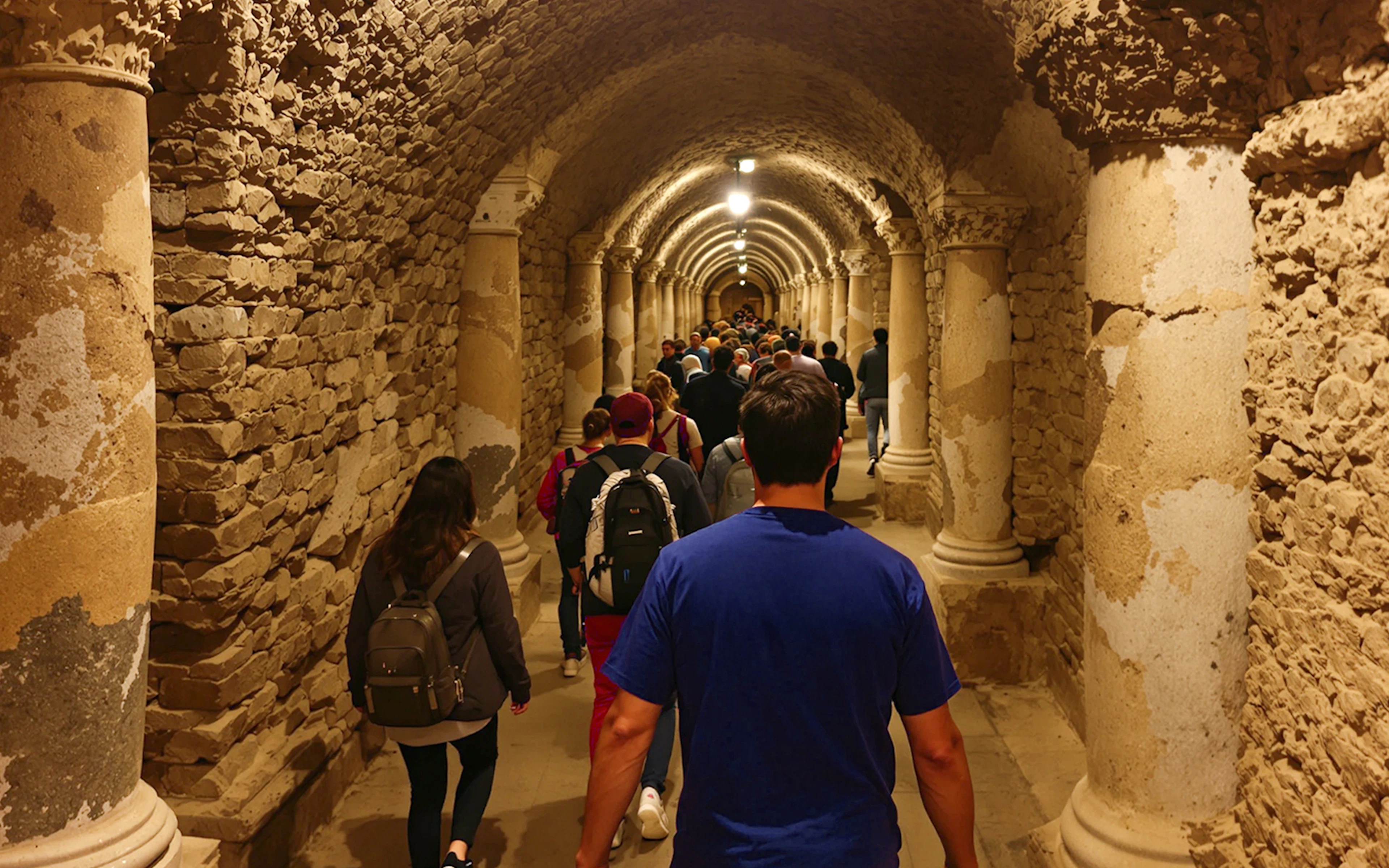
Follow the guide through selected sections of the burial network, where narrow passages open into galleries lined with ancient loculi and arcosolia. The route offers a focused look at the cemetery rather than access to its entire network.
Is the Catacombs of San Sebastian worth visiting?
Rome is loud above ground. Below it, the Catacombs of San Sebastian are quiet, cool, and narrow, with weathered burial galleries disappearing into the rock. The shift is immediate: you leave the Appian Way behind and enter a place built for burial, remembrance, and early Christian worship rather than public spectacle.
The complex began as a quarry and later became a cemetery, eventually developing into an important site of Christian devotion and pilgrimage. What stays with you is not its scale, but its intimacy: inscriptions, frescoes, ancient burial chambers, and the feeling of moving through a part of Rome that was never meant to be seen from the street.
The payoff is a slower, more contemplative side of ancient Rome, one where history feels close enough to touch, even when you cannot.
What to see at the Catacombs of San Sebastian
The Underground Galleries
The Cubicle of Jonah
Look for the 4th-century frescoes depicting Jonah and other biblical scenes. The imagery offers a glimpse into the beliefs and artistic language of early Christian communities buried here.
The Crypt of Saint Sebastian
Explore the area associated with Saint Sebastian, whose cult became closely linked to the site. The present crypt was created in the 17th century around the location traditionally associated with his burial.
The Memoria Apostolorum
Discover the area connected with the ancient veneration of Saints Peter and Paul. Surviving graffiti and archaeological remains point to the site's importance as a place of early Christian devotion.
The Ancient Mausoleums
The complex preserves three 2nd-century mausoleums from an earlier funerary landscape, with traces of frescoes and stucco decoration. They reveal that the site predates its later Christian use.
How to explore the Catacombs of San Sebastian
How much time to spend?
- The catacomb visit itself takes about 40–45 minutes. If you’re short on time, that’s enough for the core experience; allow 3–4 hours if you choose an Appian Way or basilica combination with transfers.
Best visit order
- Start at the San Sebastian complex on Via Appia Antica, where your internal guide takes you underground. The route is fixed, so you cannot choose your own sequence or wander into closed passages.
Must-see highlights
- Must-see** the burial galleries, the Memoria Apostolorum, the Cubicle of Jonah and the area associated with Saint Sebastian. Optional:** explore the Basilica of Saint Sebastian above ground if your itinerary includes it.
Worth adding nearby
- For a self-paced extension, continue along the Appian Way after your catacomb visit and explore the road and nearby archaeological sites. If you want the logistics handled, the Appian Way option adds Cecilia Metella, aqueducts and round-trip transport.
Guided or self-paced?
- There is no real self-guided alternative: San Sebastian is officially open only through an internal guided tour, so the guide is part of the experience rather than an optional upgrade. If you want more than the 40–45-minute underground visit, choose a guided combination with the Appian Way or St. Callixtus and the papal basilicas rather than trying to extend the catacomb route yourself.
Brief history of the Catacombs of San Sebastian
- 2nd century AD: The site develops along the Via Appia as a funerary complex, with pagan mausoleums and burial structures. It later evolves into a Christian cemetery, creating the layered archaeological landscape visible today.
- Mid-3rd century: The Memoria Apostolorum develops here, where Peter and Paul were believed to have been temporarily venerated together. Pilgrims left graffiti and prayers addressed to the two apostles.
- 4th century: Emperor Constantine commissions the Basilica Apostolorum above the complex, commemorating Peter and Paul and marking the site’s growing importance to early Christianity.
- Late 3rd–4th century: The martyr Sebastian, traditionally believed to have died during the persecution of Emperor Diocletian, becomes associated with the cemetery. His growing cult eventually gives the catacombs and basilica their present name.
- 17th century: The basilica and Saint Sebastian’s crypt are substantially remodelled under Cardinal Scipione Borghese, giving the complex much of its later architectural character.
- 1826–today: The Friars Minor take responsibility for the complex and continue its care. Modern archaeological work has helped uncover the site's inscriptions, mausoleums, frescoes, and evidence of the ancient Memoria Apostolorum.
Architecture of the Catacombs of San Sebastian
The Catacombs of San Sebastian feel less like a constructed monument and more like a hidden city carved into the earth. The underground galleries were cut into Rome’s soft tuff and pozzolana, with narrow corridors branching into burial chambers and walls lined with loculi, rectangular niches for the dead.
Larger arcosolia, or arched recesses containing tombs, add variety to the otherwise tightly carved passageways. Some sections also incorporate earlier quarry spaces, showing how the site’s underground architecture evolved through reuse rather than a single planned design.
Above ground, the basilica creates a striking contrast: its more formal architectural spaces, decorated chapels, and carved wooden ceiling feel deliberately composed after the raw, excavated world below.
Moving through the catacombs, visitors experience architecture at its most functional—shaped by the rock itself, with darkness, tight passages, and uneven surfaces creating an unusually immersive sense of place.
Frequently asked questions about the Catacombs of San Sebastian
No. Independent visits are not permitted. Entry to the catacombs is only with an in-house guide, and visitors must remain with their group throughout the tour.
The underground route is not wheelchair accessible and is not recommended for visitors with serious walking difficulties. The tour includes around 70 irregular steps, with no elevator or seating along the route.
No. Photography and video recording are prohibited inside the catacombs. The restriction applies throughout the underground tour, so visitors should not plan to photograph the galleries, tombs, or exhibits.
The underground areas stay around 17°C and have high humidity, so bring a light layer even in warm weather. Wear comfortable, secure shoes too, as the route includes around 70 irregular steps.
They may not be. The underground route includes narrow, enclosed passages and uneven steps, and the official visitor regulations specifically advise against visiting if you have claustrophobia.
Yes. Guided visits are offered in English as well as Italian, French, German, and Spanish. Tours are conducted by the catacomb’s internal guides, and advance reservations are recommended.
No. Bulky objects, including luggage and large bags, are not permitted inside the catacombs. Plan to visit with only the essentials, particularly since the underground route has narrow passages and steps.
No. Private guides cannot lead visitors through the catacombs independently. Visits must be conducted by the catacomb’s internal guide staff, and visitors must stay with the assigned group throughout the tour.