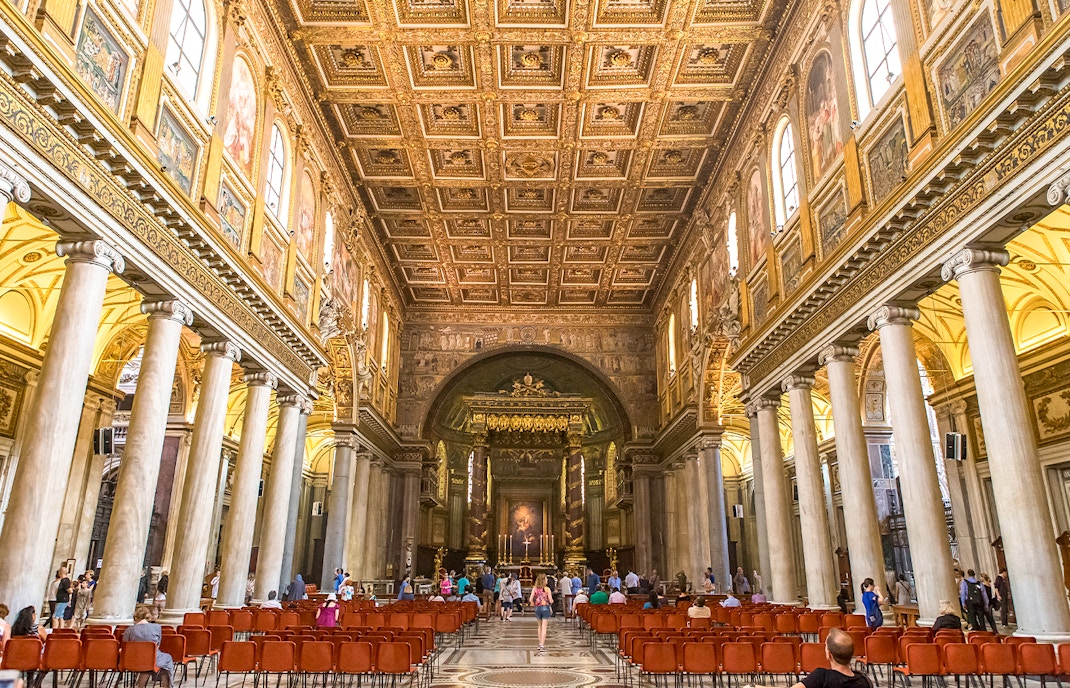
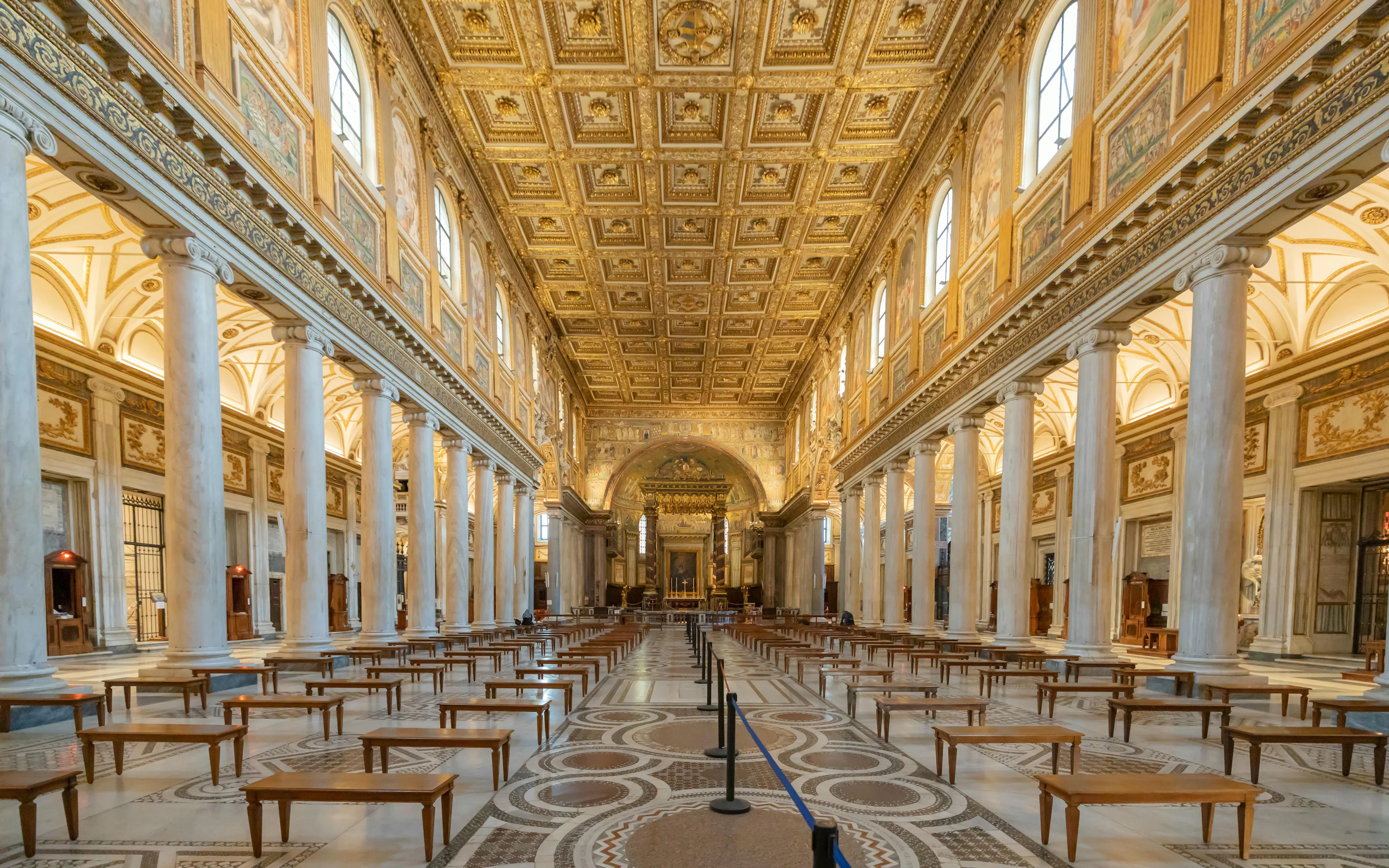
Stand at the centre of the nave, roughly halfway down, for the most complete view of the full apse. As you walk closer, the individual tesserae come into focus, each tile slightly angled to catch the candlelight.
Jacopo Torriti's Coronation of the Virgin
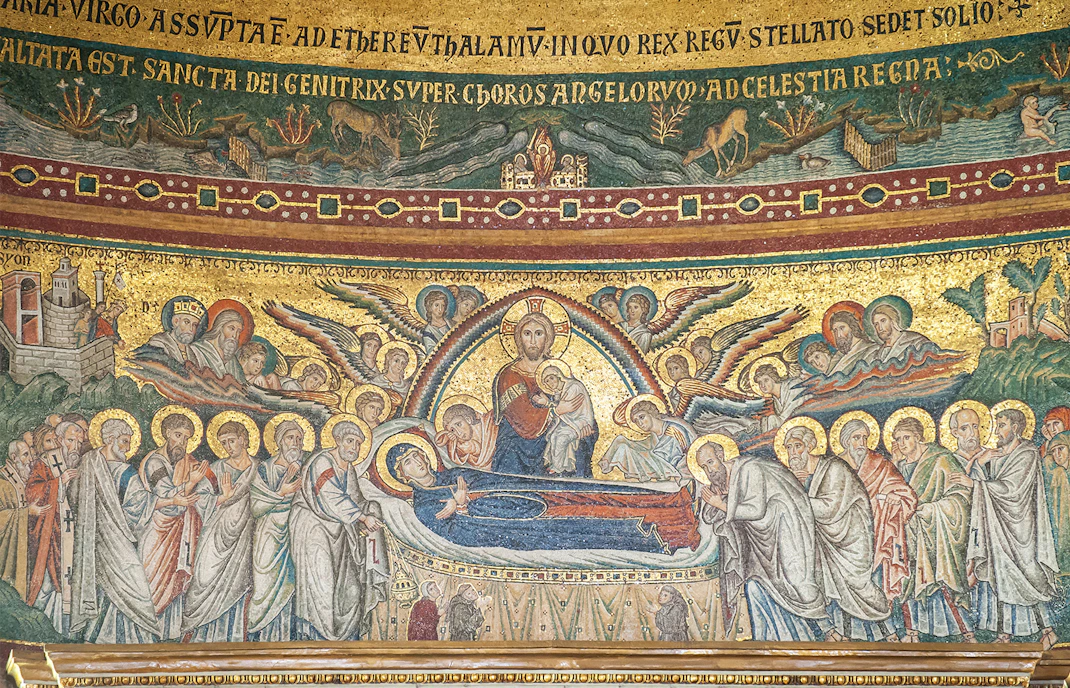
High in the apse of one of Rome's oldest and most important churches, the Coronation of the Virgin shimmers across a sea of gold mosaic tiles. Completed in 1296 by Jacopo Torriti, this sweeping composition stretches across the entire semi-dome — Christ crowning Mary amid angels, saints, and a swirling cosmos of Byzantine splendour.
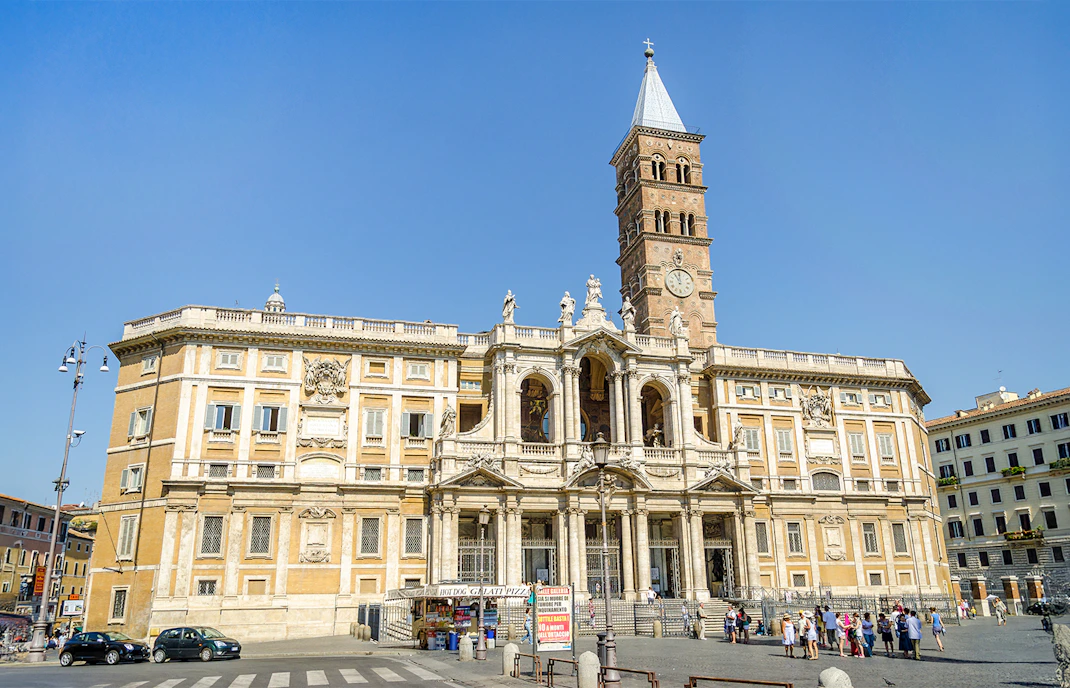
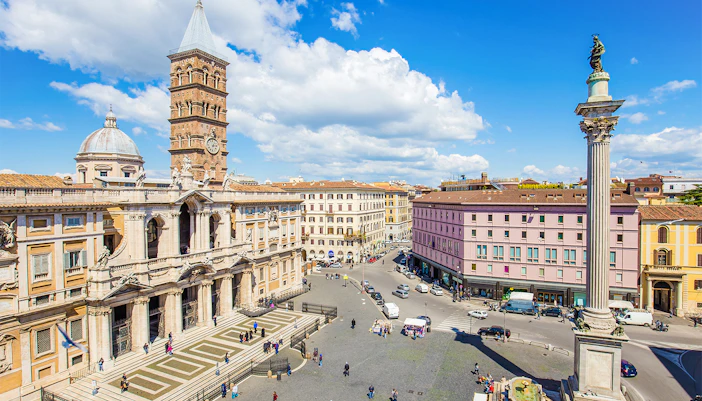
It's one of the finest mosaics in all of medieval Rome, and almost entirely intact. You'll find it at the far east end of the nave, impossible to miss the moment you step inside. No separate ticket is needed, entry to the Basilica di Santa Maria Maggiore is free.
How to best visit the Coronation of the Virgin
Did you know?
Story behind the Coronation of the Virgin
1/5
The commission · 1288–1296
A pope's vision, a cardinal's gold
Pope Nicholas IV commissioned the mosaic during a major renovation of Santa Maria Maggiore. The work was entrusted to Jacopo Torriti, a Franciscan friar and one of medieval Rome's leading mosaic artists, with funding from the powerful Colonna family.
Creation
Tesserae by tesserae, a new language
Using millions of glass and stone tesserae, Torriti and his workshop built the composition piece by piece. While rooted in the Byzantine tradition, the figures display a softer, more natural style that reflects emerging Gothic influences.
Symbolism
Mary elevated, not subordinate
At the centre, Christ crowns Mary as she sits beside him on a shared throne. This unusual arrangement emphasizes her elevated status, while the surrounding saints, angels, and radiant mandorla reinforce the scene's heavenly significance.
Survival
Seven centuries, almost untouched
The mosaic has survived remarkably well since its completion in 1296. Aside from limited restoration work, much of the original composition, colour palette, and gold background remain intact today.
Legacy
Where Byzantine ends and the Renaissance begins
The work is often seen as a bridge between Byzantine tradition and the more human-centred art of the Renaissance. Its influence can be traced through later Roman artists and remains evident in the mosaic's expressive figures.
Who created the Coronation of the Virgin?
Jacopo Torriti
Active c. 1270–1300 · Italian · Late Byzantine / Proto-Gothic
Torriti was likely a Franciscan friar as well as an artist, which goes some way to explaining why Pope Nicholas IV — himself a Franciscan — chose him for the two most prestigious mosaic commissions in Rome: the apse of San Giovanni in Laterano (1291) and this one at Santa Maria Maggiore (1296).
Little is documented about his early life, but his technical command of the Byzantine mosaic tradition is unmistakable. What sets him apart is what he adds to it: softer modelling in the faces, a more dynamic use of line, and a compositional ambition that looks forward to the generation of artists who would define the early Renaissance. The Coronation of the Virgin is widely considered the peak of his output — and one of the defining works of medieval Italian art.
What makes the Coronation of the Virgin a masterpiece?
1/5
Full composition
The sweep of the apse
Covering the entire semi-dome, the mosaic draws your eye straight to Christ and Mary at its centre. Rings of angels, saints, and decorative foliage create a carefully balanced composition that unfolds from the middle outward.
Wide apse shot from nave centre
Central figures
The coronation moment
Christ crowns Mary as they sit side by side within a shared mandorla. The gesture is both tender and symbolic, emphasizing Mary's elevated place in the heavenly hierarchy.
Close-up of central Christ and Mary figures
Technique
The gold ground up close
The gold tesserae are set at slightly different angles, causing the surface to catch and reflect light unevenly. As you move, the background appears to shimmer rather than remain flat.
Macro close-up of gold tessera field
Hidden detail
The pagan river god at the base
Look closely at the lower register and you'll find fish, water birds, and a river deity inspired by ancient Roman art. It's a subtle reminder of how classical traditions survived within medieval Christian imagery.
Lower register detail, acanthus and water band
Symbolism
The donor portraits
Tiny kneeling figures of the Colonna cardinals appear near the bottom corners of the mosaic. Easy to miss, these patron portraits reveal who helped finance one of medieval Rome's greatest artistic achievements.
Lower left and right donor figures detail
Frequently asked questions about the Coronation of the Virgin
No. The Coronation of the Virgin is located inside Santa Maria Maggiore's main basilica and can be viewed with general admission to the church.
The mosaic covers the apse above the high altar at the eastern end of the basilica. For the best overall view, stand near the centre of the nave and look toward the altar.
Most guided tours of Santa Maria Maggiore include the mosaic as one of the basilica's highlights. Art history and church-focused tours typically provide deeper insight into its symbolism, technique, and historical significance.
Early mornings shortly after opening and late afternoons are usually the quietest times. Visiting outside Mass hours also gives you more space to admire the mosaic without interruptions. See full basilica schedule →
Photography is generally permitted inside the basilica, but flash photography is not allowed. Always check current visitor guidelines, as restrictions may change during religious services or special events. Plan with confidence using our complete guide →
The mosaic is largely original to Jacopo Torriti's late 13th-century design. While conservation work has addressed localized damage over the centuries, much of the composition, colour palette, and gold background remain intact.
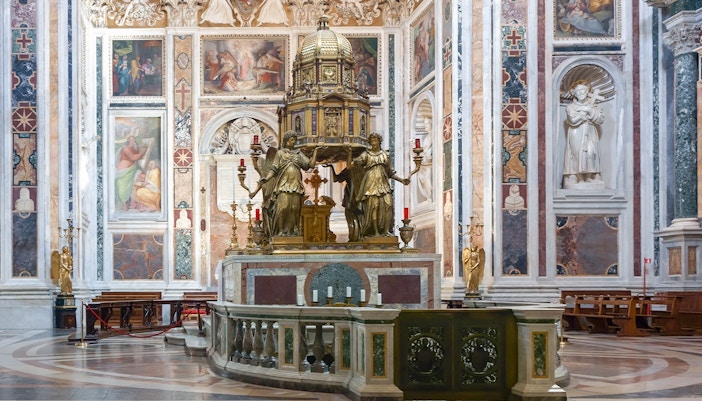
Don't miss the 5th-century nave mosaics, the richly decorated Sistine Chapel, the Pauline Chapel, the relic of the Holy Crib, and the basilica's gilded coffered ceiling. Together, they showcase over 1,500 years of art, faith, and papal patronage.